
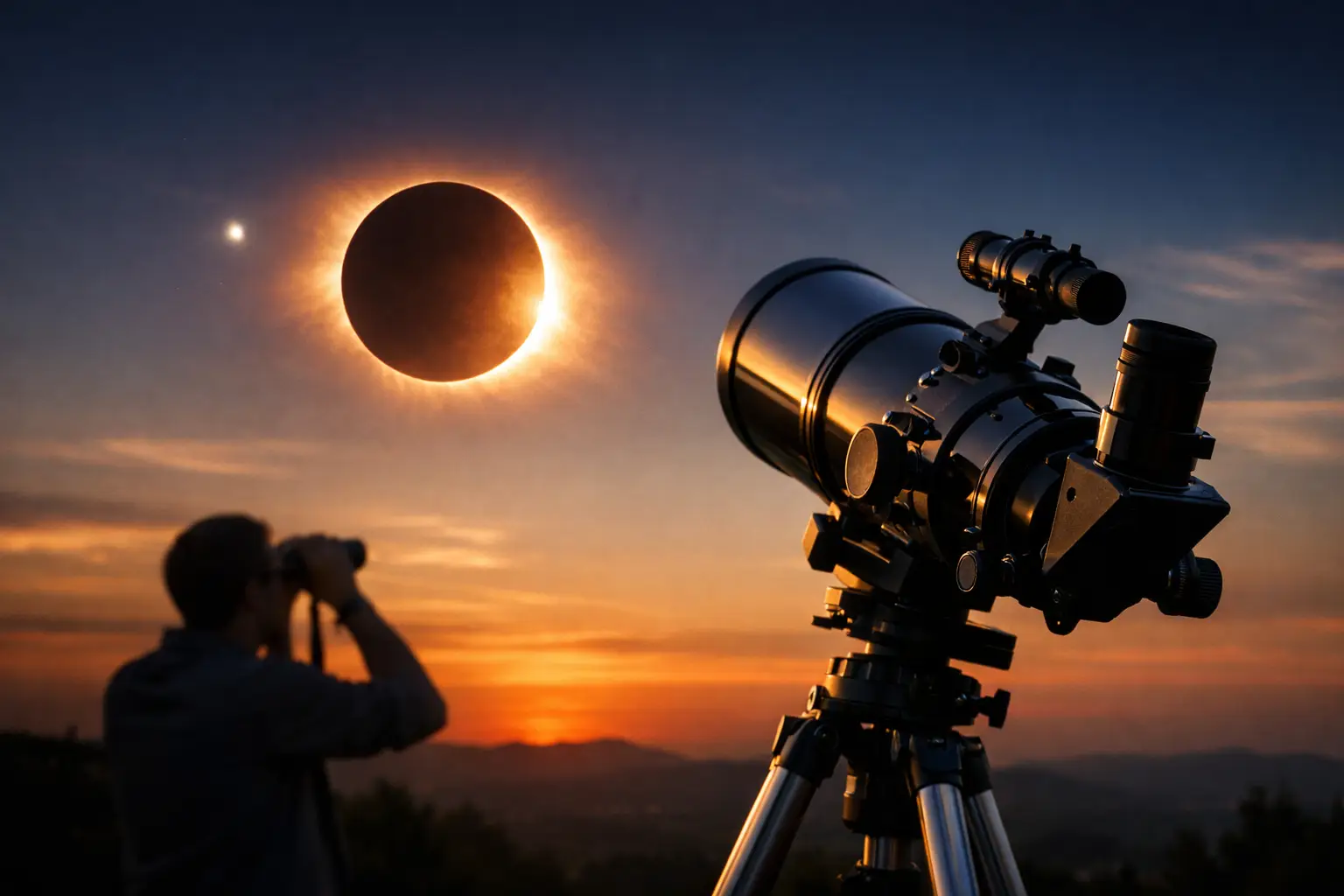
If you step outside 10 minutes late for an eclipse, you can miss the part everyone remembers. That is the real answer behind the phrase best time to see eclipse events – it is usually not a single clock time, but a short viewing window shaped by eclipse type, your location, sky conditions, and the Sun or Moon’s altitude above your horizon.
For most observers in the US, the best viewing moment is the peak phase at your location, but the best viewing period starts earlier. For a solar eclipse, that often means being set up 20 to 30 minutes before first contact and staying through maximum eclipse. For a lunar eclipse, the most dramatic window is usually the 30 to 60 minutes around totality or maximum partial phase. The exact timing can vary by hours from one city to another, which is why local eclipse calculators matter more than a national headline time.
| Eclipse type | Best viewing window | Typical duration of standout phase | Ideal altitude target |
|---|---|---|---|
| Total solar eclipse | 20-30 min before first contact through totality | Totality often 2-4 min, up to about 4.5 min on some paths | Sun above 20 degrees |
| Annular solar eclipse | 20-30 min before first contact through maximum annularity | Annularity often 1-5 min | Sun above 20 degrees |
| Partial solar eclipse | 15-20 min before first contact through maximum eclipse | Maximum phase lasts only a moment, full event often 2-3 hr | Sun above 15 degrees |
| Total lunar eclipse | 30-60 min around totality | Totality often 30-85 min | Moon above 20 degrees |
| Partial lunar eclipse | 20-40 min around maximum eclipse | Strongest visual phase often 20-40 min | Moon above 15 degrees |
The best time to see eclipse moments depends on the type
A solar eclipse is front-loaded with tension and back-loaded with relief. The partial phases can last more than 2 hours, but the most intense visual change happens near maximum eclipse. If you are inside the path of totality, the best time to see eclipse conditions is totality itself, when the Sun’s bright disk is fully covered and the corona appears. That window may last only 120 to 240 seconds in many locations. Outside the path, you will only see a partial eclipse, and maximum eclipse is your key moment.
A lunar eclipse moves at a friendlier pace. The Moon darkens gradually as it enters Earth’s shadow, then often glows copper-red during totality. Because the Moon is safe to view with the naked eye, binoculars, or a telescope, many observers prefer the longer lead-up and recovery phases as much as the peak. If totality lasts 60 to 80 minutes, you have real room to observe color changes, brightness differences, and background stars.
Why local timing beats national timing
This is where many eclipse plans go off course. A headline might say an eclipse peaks at 2:14 p.m. EDT or 18:14 UTC, but your local maximum could be several minutes earlier or later, and the eclipse magnitude may be completely different from what another state sees.
For example, during the April 8, 2024 total solar eclipse, totality began at different times across the US path. In Dallas, Texas, totality occurred at about 1:40 p.m. CDT. In Indianapolis, Indiana, it arrived around 3:06 p.m. EDT. In northern Maine, it happened after 3:30 p.m. EDT. Those differences matter because the Sun’s altitude also changed with location. A higher Sun, often 40 to 70 degrees above the horizon during midday events, usually means fewer horizon obstructions and steadier viewing than a low-angle event.
| Sample eclipse planning factor | Low end | High end | Why it matters |
|---|---|---|---|
| Solar eclipse totality duration | 0 sec outside path | About 270 sec on favorable paths | Determines whether you get the full corona experience |
| Sun altitude at maximum | 5 degrees | 70 degrees | Higher altitude usually means cleaner sightlines |
| Lunar eclipse totality duration | 0 min for partial only | About 85 min | Longer totality gives more time for visual observing and photos |
| Cloud forecast threshold | 10% | 80% | Cloud cover can matter more than perfect timing |
Best time to see eclipse conditions for photography
For photography, the best moment is not always the same as the best moment for casual viewing. If you are shooting a partial solar eclipse, the cleanest image often comes a few minutes before or after maximum, when you can still frame the shrinking or recovering solar crescent with more shape and contrast. During totality, photographers have only seconds to switch settings, and that pressure is real.
If the Sun is below 15 degrees altitude, foreground shots become more practical because you can include buildings, mountains, or trees. If the Sun is above 40 degrees, the view is usually better for pure eclipse detail, but harder for scenic composition. For a lunar eclipse, photographers often prefer the Moon between 10 and 30 degrees altitude. Lower than that, haze can soften the image. Higher than that, the Moon looks cleaner, but it is tougher to pair with a horizon subject.
The trade-off is simple. Higher altitude usually improves clarity. Lower altitude can improve atmosphere and composition.
Timing windows that matter most
For a solar eclipse, first contact is when the Moon first appears to touch the Sun’s edge. This is the start of the event, but not yet the visual high point. Second contact marks the start of totality in a total solar eclipse. Third contact ends totality. Fourth contact ends the full eclipse event. If you only have one protected viewing slot, aim for the 10 minutes before maximum eclipse through the maximum itself.
For a lunar eclipse, penumbral shading can begin subtly and may be hard for new observers to notice. The stronger visual show starts once the Moon enters the umbra, Earth’s darker central shadow. If you want the most obvious change, start watching 20 to 30 minutes before maximum eclipse. If totality occurs, stay with it. The red coloration can shift noticeably over 10 to 20 minutes.
Weather can change the best time to see eclipse events
Clear skies beat perfect geometry every time. If one location offers 95% eclipse coverage under a 15% cloud forecast and another offers 100% coverage under a 75% cloud forecast, the first location may be the smarter mission choice. That is especially true for partial and annular eclipses, where a thin cloud deck can erase fine detail.
For solar eclipses, scattered afternoon cumulus clouds can build fast in spring and summer. Morning eclipses sometimes benefit from more stable air, but low-angle haze can be a problem. Lunar eclipses are more forgiving because the event lasts longer, so holes in the cloud deck can still save the night.
This is why experienced observers do not just ask for the best time to see eclipse events. They ask for the best combination of timing, altitude, and forecast within driving range.
How early should you be outside?
Earlier than you think. For a solar eclipse, be fully set up at least 20 minutes before first contact. If you are traveling to the path of totality, add buffer time for traffic, parking, and equipment setup. On major eclipse days, local roads can slow dramatically within 30 to 80 miles of the centerline.
For a lunar eclipse, getting outside 30 minutes before the partial phase starts gives your eyes time to adjust and helps you compare the uneclipsed Moon to the darkening disk. If the event begins before moonrise in your area, your best time may actually be moonrise plus the next 15 to 30 minutes, assuming the Moon clears local obstacles.
A practical US viewing checklist
If you want a fast decision rule, use this. For solar eclipses, the best viewing time is maximum eclipse at your exact location, with setup complete at least 20 minutes before first contact and safe solar glasses used during all partial phases. For total solar eclipses, the true peak is totality, which can last just 2 to 4 minutes. For lunar eclipses, the best viewing time is the 30 to 60 minutes centered on totality or maximum eclipse, ideally with the Moon at least 20 degrees above the horizon.
This is where a real-time planning tool earns its keep. SpaceInformer-style tracking works best when it gives you the local start time, peak time, end time, Sun or Moon altitude, azimuth, and cloud forecast in one view instead of forcing you to patch the event together from five different sources.
The next time an eclipse is on the calendar, do not settle for the national peak headline. Find your local maximum, check the altitude, scout the horizon, and give yourself a time buffer. The sky rewards people who are ready a little early.