
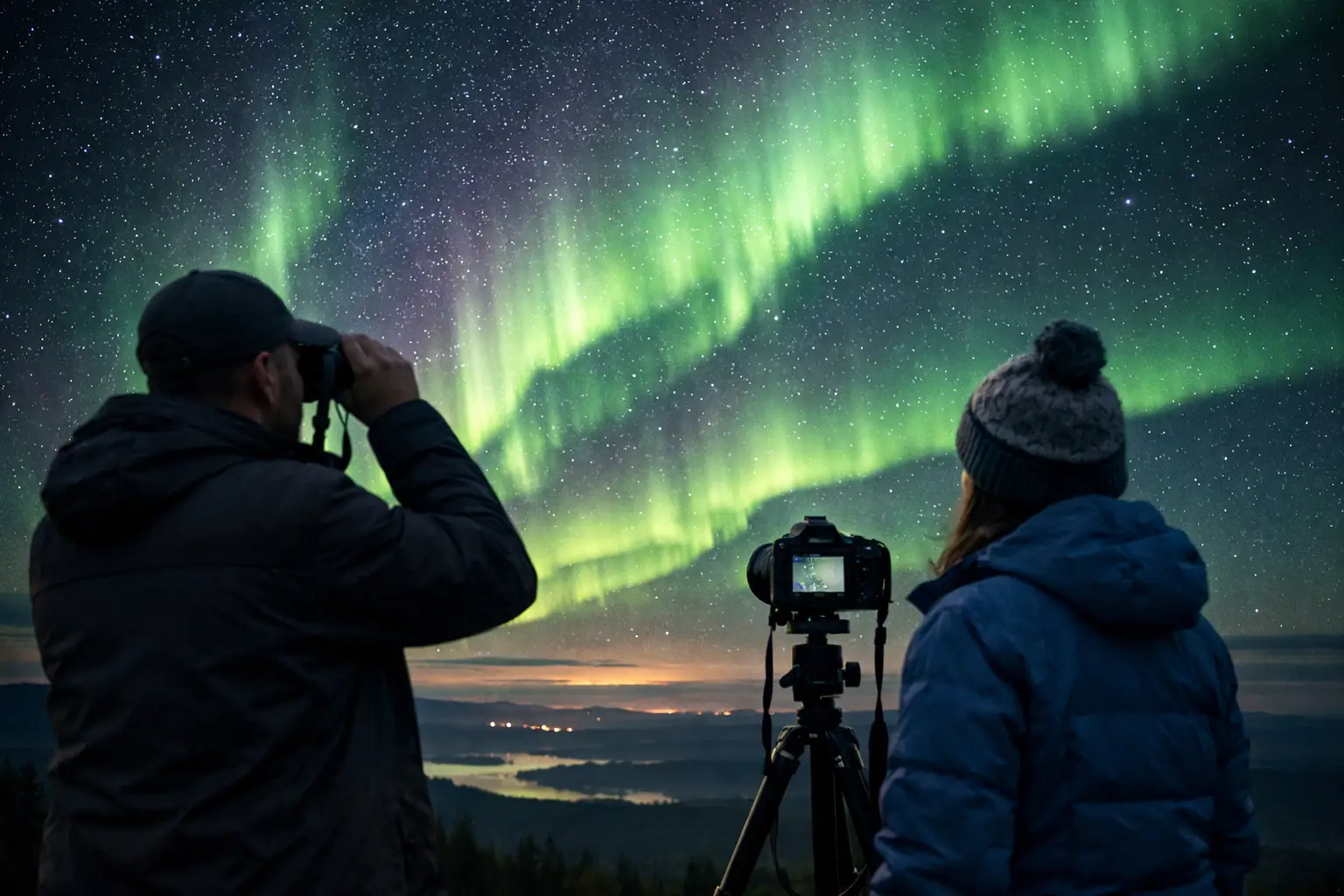
The aurora forecast tonight is not a single yes-or-no signal. For US observers on the night of July 21-22, 2026, the real mission is to combine geomagnetic activity, your latitude, local cloud cover, and darkness into one fast viewing decision. A modest aurora can be spectacular from northern Minnesota or Alaska while remaining completely hidden from a clear sky in Illinois.
| Forecast factor | Useful threshold | What it means tonight |
|---|---|---|
| Planetary Kp index | Kp 5 = G1 storm; Kp 7 = G3 storm | Higher Kp can push the aurora farther south. |
| Local darkness | About 10:00 PM-2:00 AM local time | This is often the strongest observing window, though bursts can happen earlier or later. |
| Cloud cover | Below 30% preferred | A strong storm above solid clouds is still invisible from the ground. |
| Northern horizon | Clear view from 0° to 20° altitude | At mid-latitudes, the first visible glow may sit low in the north. |
What the aurora forecast tonight can actually tell you
Aurora forecasting begins upstream of Earth, roughly 1.5 million km sunward at the L1 observation point. Solar-wind monitors there can detect changes in particle speed, density, and magnetic field before that material reaches Earth. Depending on solar-wind speed, the final warning may be only 15 to 60 minutes.
That is why a 24-hour aurora outlook is a planning tool, not a promise. A coronal mass ejection may arrive earlier or later than modeled. Even after it arrives, the direction of the interplanetary magnetic field matters enormously. When its north-south component turns southward, often described as a negative Bz value, energy couples more efficiently into Earth’s magnetosphere and auroral activity can intensify quickly.
The planetary Kp index is the easiest public-facing number to follow. It runs from 0 to 9 in 3-hour intervals and describes global geomagnetic disturbance. Kp is useful, but it does not show every short-lived substorm. A quiet-looking forecast can still produce a vivid 10-minute arc or pulsating patch. Conversely, a high Kp reading does not override rain, haze, a bright porch light, or a blocked northern horizon.
How far south could the lights appear?
There is no fixed state-by-state boundary. Visibility depends on whether you are directly beneath the auroral oval or looking toward it from farther south. The difference matters: observers in Fairbanks may see curtains overhead at a level of activity that produces only a faint green band 5° above the horizon in Duluth.
| Approximate activity | Most favorable US viewing regions | Likely appearance |
|---|---|---|
| Kp 3-4 | Alaska, northern Canada border regions, far northern Minnesota | Low northern glow or structure near the horizon. |
| Kp 5-6 | North Dakota, Minnesota, Wisconsin, Michigan’s Upper Peninsula, northern New England | Brighter arcs, possible rays, and more camera-visible color. |
| Kp 7-8 | Parts of the central US and the northern Mid-Atlantic may have a chance | Aurora can rise higher, with stronger color and broader visibility. |
These ranges are approximate, not a guarantee. Local magnetic latitude is more useful than a simple map of geographic latitude, and an observer with a dark lakefront horizon can outperform someone 100 miles farther north under city glare.
For July 21 in the Lower 48, the late-summer-style observing rhythm is already underway, but northern twilight still matters. In locations such as Minneapolis, Minnesota, true darkness is limited compared with autumn and winter. The best practical approach is to wait until the northern sky has fully darkened, then keep watching through local midnight. In Alaska, daylight conditions vary dramatically by latitude, so do not assume a high Kp automatically equals a usable dark-sky window.
Launch your observation plan in three checks
First, check the latest geomagnetic outlook and the 30-minute solar-wind data shortly before heading out. The operational question is simple: Is activity rising, steady, or fading? A rising trend with a southward magnetic field is more encouraging than a Kp value that peaked several hours earlier.
Second, check cloud cover at the exact hour you intend to observe. A forecast showing 20% cloud cover at 11:00 PM is materially different from 80% cloud cover at 1:00 AM. Thin high cloud can also wash out a weak aurora even if stars remain visible. If your local sky is cloudy, driving 30 to 60 miles toward a clear patch can be more valuable than waiting for a higher Kp reading.
Third, pick a site with a genuinely open northern view. You do not need a remote expedition for every event, but you do need to get away from direct light sources. Aim for a location where the northern horizon is unobstructed for at least 90 degrees from northwest to northeast. Shorelines, open farm roads, ridgelines, and dark parks can work well when they are legal and safe to access.
Give your eyes 20 to 30 minutes to adapt. Avoid staring at a bright phone screen. Use the dimmest red screen setting available, keep headlights pointed away from your observing area, and scan the full northern sky rather than locking onto one point. The first sign is often not a dramatic curtain. It may look like a pale gray-green cloud, a thin arc, or a vertical ray that seems oddly fixed compared with ordinary clouds.
Your camera may see the aurora first
Modern phones are useful aurora detectors because multi-second night exposures collect more light than your eyes. That can reveal green, purple, or red color in a display even when the sky looks nearly colorless overhead. But the camera is not the final judge of whether conditions are improving. Watch the shape and motion.
Use a tripod or brace the phone against a stable surface. Start with Night mode enabled and an exposure of roughly 3 to 10 seconds if the device allows it. A dedicated camera can begin around ISO 800 to 3200, an aperture of f/1.4 to f/2.8, and a 2- to 8-second exposure. Longer exposures brighten a faint scene, but they can blur fast-moving rays and make a weak glow look stronger than it appeared in real time.
If the aurora is low, include a dark foreground such as water, trees, or a barn only if it does not block the horizon. Composition is secondary to awareness: look up between every set of images. The show can transform in minutes.
Know when to stay out and when to call it
Stay on watch when the northern glow is gaining height, rays are becoming defined, or images show increasing color over consecutive 5-minute intervals. A substorm can expand rapidly and may last 15 to 45 minutes before fading. If activity has been flat for an hour, clouds are thickening, and the solar-wind trend is weakening, the odds are falling.
Do not treat a low forecast as a reason to ignore the sky completely, especially from Alaska, northern Minnesota, northern Michigan, and northern Maine. Nor should a high forecast send you to an unsafe roadside or private property. Bring layers, water, a charged phone, and a plan for getting home. Summer nights can still cool quickly, particularly near the Great Lakes.
Tonight’s best aurora strategy is simple: use the forecast to choose your window, use clouds to choose your location, and use your own eyes to catch the moment the northern sky starts moving.