
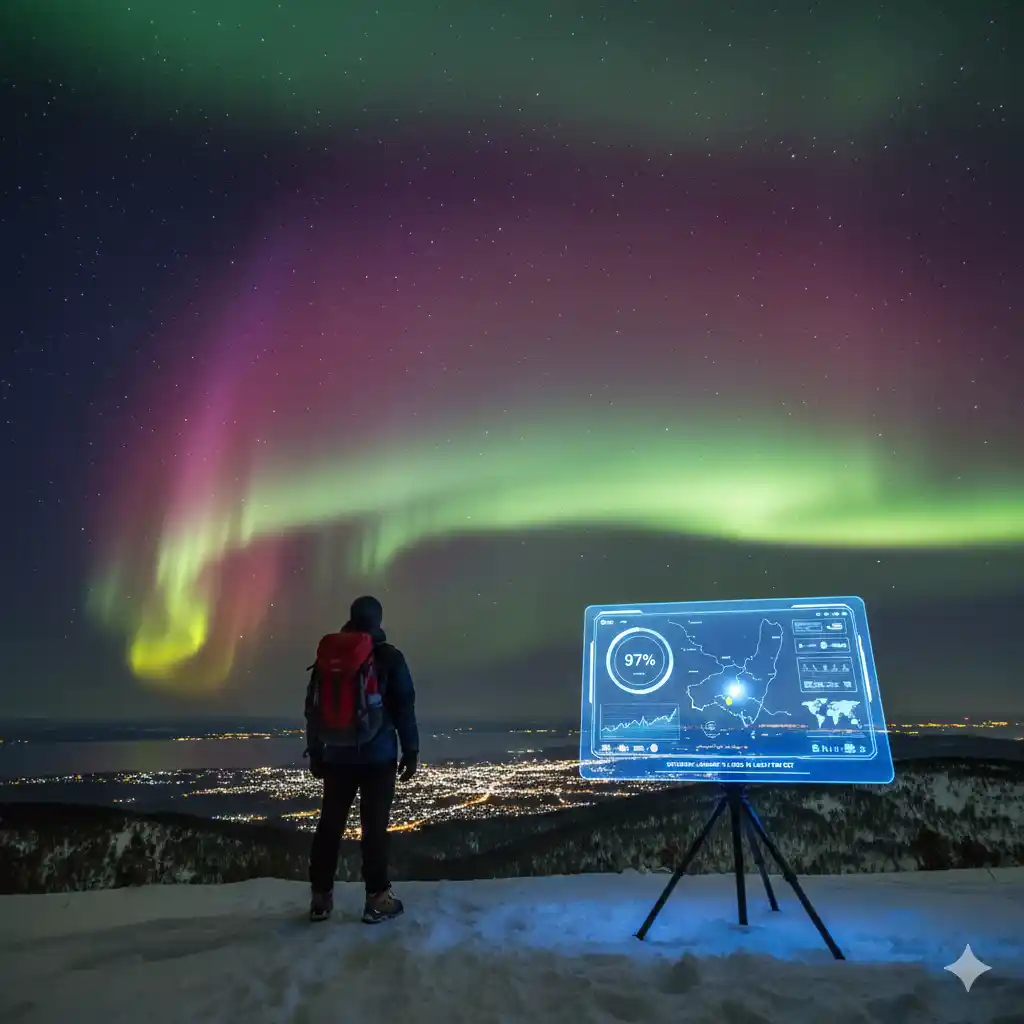
🌌 Hobart Aurora Live Tracker
Real-time Southern Lights Forecast for Hobart, Tasmania
Loading…
Connecting to NOAA space weather satellites…
Southern Visibility Guide
✨ Data updates frequently. Refresh for the latest solar activity.
Current Aurora Oval (Southern Hemisphere)
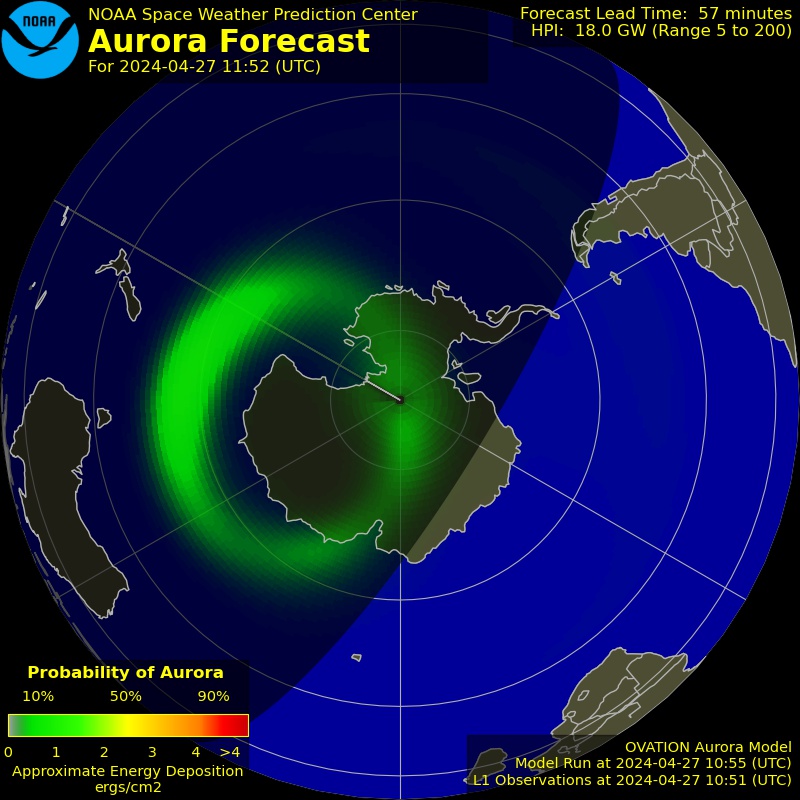
Data provided by NOAA / Space Weather Prediction Center
Switch to Other Southern Viewpoints
The Magnetic Quirk That Works in Tasmania’s Favor
Hobart sits at about 42.9°S — noticeably closer to the equator than Tromsø or Fairbanks are to the North Pole, yet it’s still one of the most reliable aurora australis viewing spots on Earth. The reason is a genuine quirk of geophysics: Earth’s south geomagnetic pole isn’t aligned with the geographic South Pole — it’s offset toward the Indian Ocean side of Antarctica, which pulls the auroral oval noticeably closer to Tasmania than a simple latitude comparison would suggest. In practice, this means Hobart’s geomagnetic latitude is meaningfully higher than its geographic latitude, which is why a location roughly level with Melbourne or Christchurch outperforms what its position on a map implies.
Face South, Not North
This is the detail that trips up most first-time aurora hunters in Tasmania, especially anyone who’s chased the lights in the Northern Hemisphere before: in Hobart, you look south, toward Antarctica, not north. The aurora australis appears low on the southern horizon over the water, which means your viewing spot needs an open, unobstructed line south — the opposite of what you’d scout for in Norway or Alaska. It also means Hobart’s own city lights, which sit to the north of most good viewing points, aren’t actually the obstacle they’d be for a northern-hemisphere city; the light pollution that matters most here comes from any settlement or glow directly to your south.
Where Locals Go Chasing Around Hobart
South Arm, about 30 minutes from the city center, is the default choice for a reason: it’s a low, open peninsula with a clear, uninterrupted view across Storm Bay toward Antarctica, and it’s close enough for a spontaneous late-night trip when activity spikes. Goat Bluff and Clifton Beach offer a similar southward opening with easier parking, while Tinderbox, on the Channel Highway side, adds an elevated vantage point that lifts you above any coastal haze. For a more committed trip, Bruny Island — a short ferry ride south of Hobart — pushes you even further from any residual city glow, at the cost of needing to time the crossing around ferry schedules.
The Facebook Group That Runs the Whole Scene
Aurora tourism infrastructure in Tasmania is younger and far less commercialized than in Norway or Iceland — there’s no dense network of guided tours or aurora villages here. Instead, the community effectively organizes itself through a single, heavily active Facebook group (“Aurora Australis Tasmania”), where local photographers post real-time camera test shots the moment they spot a glow on their screens, often well before it’s visible to the naked eye or reflected in any global index. For visitors, checking that group alongside a Kp tracker is closer to how locals actually operate than relying on any single forecast tool alone.
Best Season and What a Good Night Looks Like
Tasmania’s aurora season leans toward the Southern Hemisphere winter — roughly April through September — when nights are longest and skies tend to be clearer of the moisture that summer brings off the Tasman Sea. On a quiet night, expect a faint reddish or greyish-green glow low on the southern horizon, often mistaken at first for distant town lights or a fishing boat. On an active night, the glow lifts, gains structure, and can show the same pillars and rapid color shifts — greens shading into deep red — that define a strong display anywhere in the world, just with Antarctica on the other side of it instead of the Arctic.