
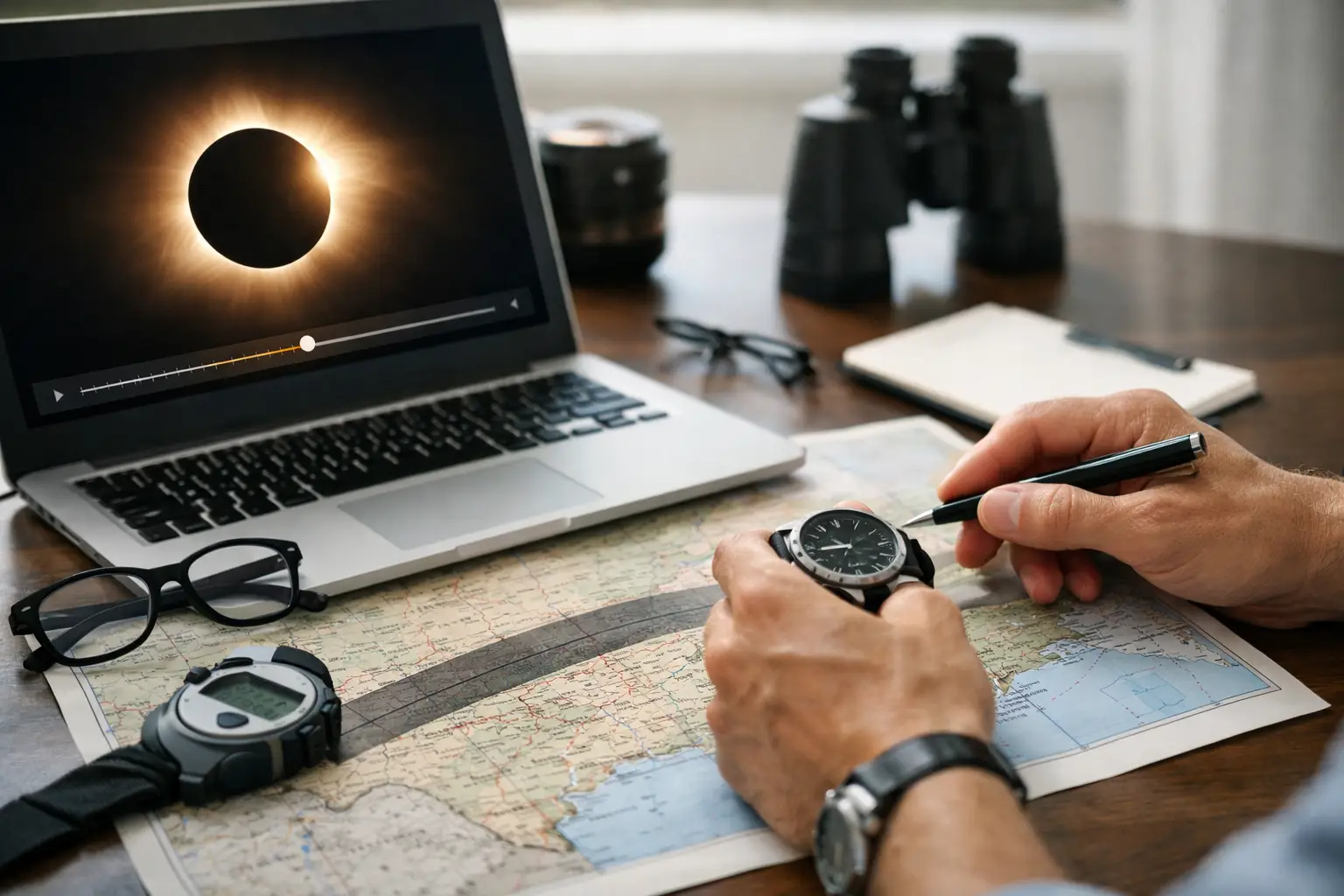
A total solar eclipse does not wait for late arrivals. The most dramatic phase can last less than 2 minutes at one location, while the first partial bite from the Sun begins more than an hour earlier. Knowing how to plan eclipse timing means building your day around precise local contact times, not the headline time shown for an entire country or eclipse path.
Start with the event clock, then turn it into a location-specific mission plan. The upcoming total solar eclipses below show why the distinction matters: maximum duration is measured at the point of greatest eclipse, not automatically from your viewing field.
| Eclipse date | Event | Greatest eclipse time (UTC) | Maximum totality duration |
|---|---|---|---|
| August 12, 2026 | Total solar eclipse | 17:46 UTC | 2 minutes 18 seconds |
| August 2, 2027 | Total solar eclipse | 10:07 UTC | 6 minutes 23 seconds |
| July 22, 2028 | Total solar eclipse | 02:56 UTC | 5 minutes 10 seconds |
How to plan eclipse timing from your exact location
Your first task is to enter the exact observing location into an eclipse calculator or live planning tool. Use a street address, campground coordinates, or a map pin – not just the nearest city. A location 30 miles from the centerline can have a noticeably shorter totality window, and a site outside the path of totality will see only a partial solar eclipse.
For a solar eclipse, record five local times: first contact, second contact, maximum eclipse, third contact, and fourth contact. First contact, also called C1, is when the Moon first appears to touch the Sun. Second contact, C2, is the instant totality begins. Third contact, C3, ends totality. Fourth contact, C4, is the final moment the Moon leaves the solar disk.
C2 and C3 are the mission-critical times. They define the only period when the Sun’s bright surface is fully covered for observers inside the path of totality. At all other times, including the partial phases before C2 and after C3, certified solar eclipse glasses are required for direct viewing.
Do not confuse the time of maximum eclipse with totality. Maximum is the midpoint of the event at your location. If totality lasts 1 minute 40 seconds, maximum occurs roughly 50 seconds after C2 and 50 seconds before C3. That is useful for photography and observations, but it is not the moment to begin looking up.
Convert UTC correctly, then check daylight saving time
Global eclipse predictions are often published in Coordinated Universal Time, or UTC. In the continental United States, UTC is usually 4 to 8 hours ahead of local civil time, depending on time zone and daylight saving time. Eastern Daylight Time is UTC-4, Central Daylight Time is UTC-5, Mountain Daylight Time is UTC-6, and Pacific Daylight Time is UTC-7.
That conversion is only a starting point. Your final schedule should show local time with the time zone written out. A note saying “C2 at 2:14” is an avoidable failure point. Write “C2 at 2:14:36 p.m. CDT” or the equivalent for your site. If you are traveling across time zones, set your phone, watch, camera, and vehicle clock to the destination zone the night before.
The August 12, 2026 total solar eclipse is a good example of why this matters. Its greatest eclipse occurs at 17:46 UTC, but the totality path crosses Greenland, Iceland, and Spain, each with different local clock conventions. The published UTC time is a global reference, while your local circumstances determine when you need to be ready at the field.
Choose a site for duration, altitude, and an escape route
The centerline of totality generally provides the longest possible duration, but it is not always the best observing site. A ridge, coastal overlook, or airport-adjacent field may have a clearer horizon and faster road access than a nominally better point near the centerline.
Check the Sun’s altitude at C2 and C3. If the Sun is below 15 degrees above the horizon, trees, buildings, mountains, and even a low bank of cloud can erase the view. At 10 degrees altitude, an object is only about one fist-width above the horizon when you hold your arm out straight. That can be spectacular, but it demands a completely open sightline.
Also inspect the eclipse path width. Near the centerline, the Moon’s shadow can be tens to more than 100 kilometers wide, depending on the eclipse. Near its edge, totality shrinks rapidly. Moving even 10 to 20 kilometers toward the path interior can add valuable seconds, while moving the same distance toward the boundary may cost totality altogether. Use a path map with duration contours, not just a broad shaded band.
The Moon’s shadow is moving fast. Its ground speed changes through the event and can exceed 2,000 km/h. You cannot chase a gap in cloud once totality is underway. Your weather decision needs to happen early enough to travel safely to a preselected alternate site.
Build a countdown that survives real-world friction
A dependable eclipse schedule includes more than the celestial contacts. Plan to arrive at least 90 minutes before C1 if you need to park, walk to a site, set up a tripod, or coordinate with family. For a high-attendance event, 3 to 5 hours before C1 is more realistic. Road congestion after totality can be severe, especially where a single highway serves the path.
Set three alarms: 30 minutes before C2, 10 minutes before C2, and 2 minutes before C2. The first is for final camera framing and gear checks. The second is for putting eclipse glasses on, stopping casual conversation, and confirming everyone knows the safety plan. The last is your cue to watch the partial crescent, changing light, and approaching shadow without scrambling through a backpack.
If you are photographing, pre-program exposure settings and focus before C2. Cameras can consume the short totality window if you are changing lenses or hunting through menus. A simple plan often wins: capture a few planned frames, then spend the rest of totality looking up. No image is worth missing the event itself.
Synchronize your primary timepiece automatically through a cellular or network time service before leaving. Do not rely on an analog watch that may be several minutes off, and do not assume a car clock is accurate. For a 6-minute eclipse, a 2-minute error is inconvenient. For a 60-second totality, it is catastrophic.
Weather timing: make the call before the shadow arrives
Begin watching cloud forecasts 7 days out, but treat the final 24 hours as the decisive period. Look beyond a single weather icon. Check cloud cover by altitude, since high cirrus can soften the view while low clouds can block it completely. Satellite imagery during the final morning provides the most current picture of cloud movement.
Give your backup plan a measurable trigger. For example, if forecast cloud cover remains above 70% at your primary site by 6 hours before C1, drive to your alternate location. The best backup is usually within 100 to 300 km and has a different local weather pattern, not simply a field 10 miles down the road.
For a lunar eclipse, the clock is less brutal because totality can last more than an hour. But the same approach applies: get local penumbral, partial, and total-phase times; check Moon altitude; and be on site before the partial phase begins. A lunar eclipse is visible from the entire nighttime side of Earth, so the timing challenge is often moonrise, moonset, or local clouds rather than a narrow shadow path.
Run one final safety and observation check
Solar eclipse glasses should meet the ISO 12312-2 standard and be free of scratches, punctures, or loose filters. Cameras, binoculars, and telescopes need purpose-built solar filters securely attached before C1. Remove eye protection only during totality, and put it back on before C3 unless you are using properly filtered optical equipment.
The best eclipse plan is not a perfect spreadsheet. It is a local clock, a clear horizon, a weather alternative, and enough margin to be calm when the sky starts changing. Set those pieces in motion early, then let the final countdown turn a rare astronomical prediction into a moment you actually experience.