
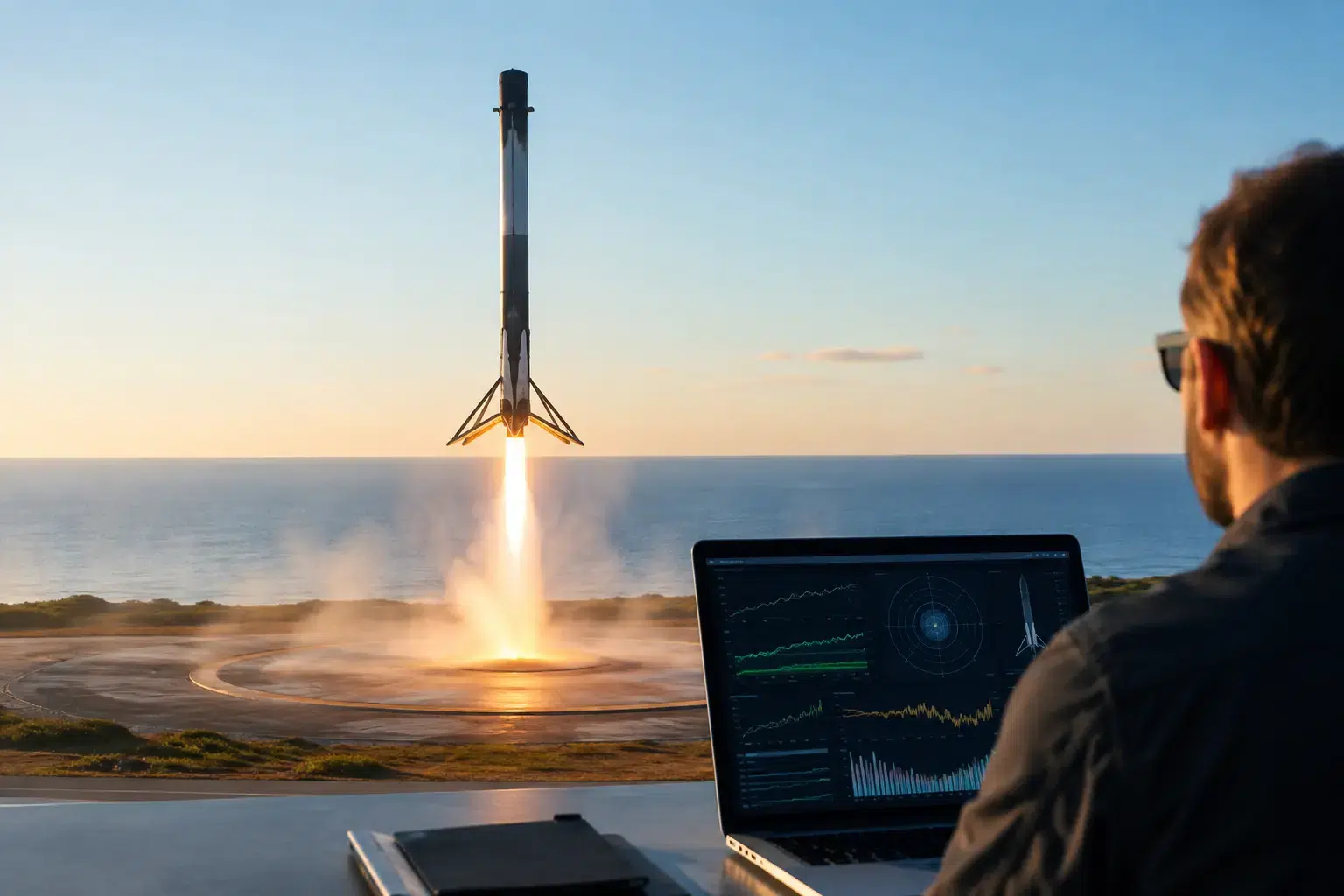
A booster landing is not a dramatic pause after launch. It is a second, tightly timed flight that begins while the upper stage is still climbing toward orbit. Rocket landing analysis turns that final descent into measurable events: when the stage flips, how fast it is falling, how much propellant remains, and whether its engines can remove nearly all of that velocity before touchdown.
| Landing phase | Typical value | Unit | Why it matters |
|---|---|---|---|
| Atmospheric reentry | About 70 | km altitude | The atmosphere begins doing meaningful work against a descending stage. |
| Reentry speed | 5,000-7,000 | km/h | Heat, drag, and attitude control become the dominant constraints. |
| Final landing burn start | Roughly 1 | km altitude | There is little time left to cancel downward speed and align with the target. |
| Touchdown speed | Near 0 | km/h vertical | The landing legs and deck cannot absorb a high-speed impact. |
Those figures are useful reference points, not fixed rules. A return-to-launch-site landing and an autonomous drone-ship landing have different energy budgets, trajectories, and weather limits. A booster recovering after a lighter payload mission may reserve more propellant for its return than one sent on a higher-energy mission.
Why rocket landing analysis starts before separation
The most visible part of a landing lasts less than a minute. The decision that makes it possible is made before liftoff. Mission planners reserve propellant for boostback, reentry, and landing burns, and that reserve directly competes with payload performance.
A rocket delivering a payload to a low Earth orbit can sometimes turn back toward the launch site. That maneuver requires a major boostback burn, which changes the stage’s downrange path. A drone-ship recovery accepts a landing point hundreds of kilometers offshore, reducing the boostback requirement but demanding a precisely positioned ocean platform.
This is why an apparently similar launch can produce a completely different recovery profile. Falcon 9 first landed a first stage at Cape Canaveral Landing Zone 1 on December 21, 2015. Its first successful autonomous drone-ship landing followed on April 8, 2016. Both were landmark moments, but they solved different guidance and propellant problems.
The primary question is not simply, Can the rocket land? It is whether the vehicle has enough controllable energy left at every point in the return. Engineers track position, velocity, acceleration, attitude, angular rates, engine performance, tank pressure, and propellant mass estimates. A small error in any one measurement can become significant when the target is a landing pad only tens of meters across.
Rocket landing analysis follows energy, not just altitude
Altitude is the number most viewers see first, but velocity tells the more urgent story. A stage can be low and still moving far too fast to survive. It can also be high, descending under control, and have a comfortable amount of time to correct its path.
During descent, a booster sheds energy in two ways: aerodynamic drag and engine thrust. Grid fins, where fitted, steer the vehicle through denser air by changing the angle at which the stage meets the airflow. They do not stop the rocket on their own. Their job is to guide the stage toward the correct corridor while managing heating and maintaining a stable orientation.
The reentry burn reduces peak heating and deceleration loads. The landing burn then handles the final velocity problem. For a vertical landing, the engines must produce enough thrust to overcome gravity and reduce the remaining downward speed. If thrust begins too early, the stage may run short of propellant or drift off target. If it begins too late, no amount of last-second steering can reverse the outcome.
That is the tension behind the familiar fast descent. The vehicle is not aiming to hover for a long time. Hovering consumes propellant quickly. Instead, it follows a continuously updated trajectory that reaches near-zero vertical velocity at the instant its legs meet the pad or deck.
The target is moving too
For drone-ship landings, the target is not a fixed dot on a map. Ocean swells can move the deck, winds can push the descending booster sideways, and the ship must maintain a specified location and heading. The final guidance system uses onboard sensors and navigation data to refine the target state right up to touchdown.
A video can make a near-center landing look effortless, but the visual result is only one part of the data. Analysts compare the touchdown point with the intended aim point, lateral velocity, tilt angle, and engine throttle behavior. Landing near the edge may still be acceptable if the stage is upright, stable, and structurally within limits. A perfect centerline touchdown is impressive, but it is not the only definition of mission success.
What to watch in a live landing feed
A public webcast rarely exposes every engineering channel, yet it still provides enough information for a useful live read. Track the mission timeline first. Listen for stage separation, entry burn ignition, grid-fin deployment, landing burn ignition, and landing confirmation. Those callouts establish the sequence better than trying to estimate events from video delay alone.
Next, watch the stage’s orientation. After separation, the first stage may coast engine-first, flip for its return, and later settle into an engine-down attitude. A controlled attitude during the bright, turbulent reentry segment is a strong sign that the vehicle remains inside its planned guidance corridor. It is not proof of a successful landing, because the most demanding propellant and timing decisions are still ahead.
For the final seconds, look at three visual cues together: the engine plume, the apparent rate of descent, and the relationship between the stage and target. A plume that grows brighter and more defined generally indicates the landing burn is underway. The stage should visibly decelerate, though camera zoom and perspective can be misleading. Near touchdown, the legs deploy and the body should remain nearly vertical rather than rotating or translating rapidly across the deck.
Do not overinterpret a temporary telemetry dropout. Exhaust plumes, vibration, condensation, sea spray, and video compression can obscure the view. The definitive public indicator is the mission callout confirming touchdown, followed by imagery showing the vehicle standing safely after the engines shut down.
The narrow margin behind a soft touchdown
Landing legs are designed for a controlled final contact, not to rescue a hard impact. The stage also has to manage residual motion after engine cutoff. A small sideways velocity, an uneven deck motion, or a tilt beyond the safe envelope can turn a technically gentle touchdown into a tip-over risk.
Engine capability matters here. Deep throttling allows a booster to reduce thrust as it approaches the target, but throttle response has limits. A vehicle cannot instantly command any thrust level it wants, and the minimum available thrust influences how late and how precisely a landing burn can begin. Atmospheric density, winds, vehicle mass, and the number of operating engines all change that calculation.
The catch of a Super Heavy booster by launch tower arms on October 13, 2024, during Starship’s fifth integrated flight test, showed how the landing target can evolve beyond a pad or ship deck. That return demanded extreme navigation precision around fixed tower infrastructure. It also carried a different set of operational risks: a missed target is not merely an off-center landing, but a potential hazard to ground equipment.
Turn every landing into a better spaceflight read
The best way to follow a recovery is to treat it as its own mission phase, not a post-launch bonus. Before launch, check whether a return-to-launch-site, drone-ship, or expendable profile is planned. During the webcast, mark the burn sequence and compare it with the expected timeline. After touchdown, look for the details that explain the result: landing location, weather conditions, vehicle condition, and whether the booster will return for refurbishment.
SpaceInformer mission tracking can put the ascent and recovery story on the same screen, but the most satisfying part is knowing what the numbers mean. On the next landing attempt, watch the final burn with a new perspective: every second of controlled descent is the visible result of a flight plan that began long before the countdown reached zero.