
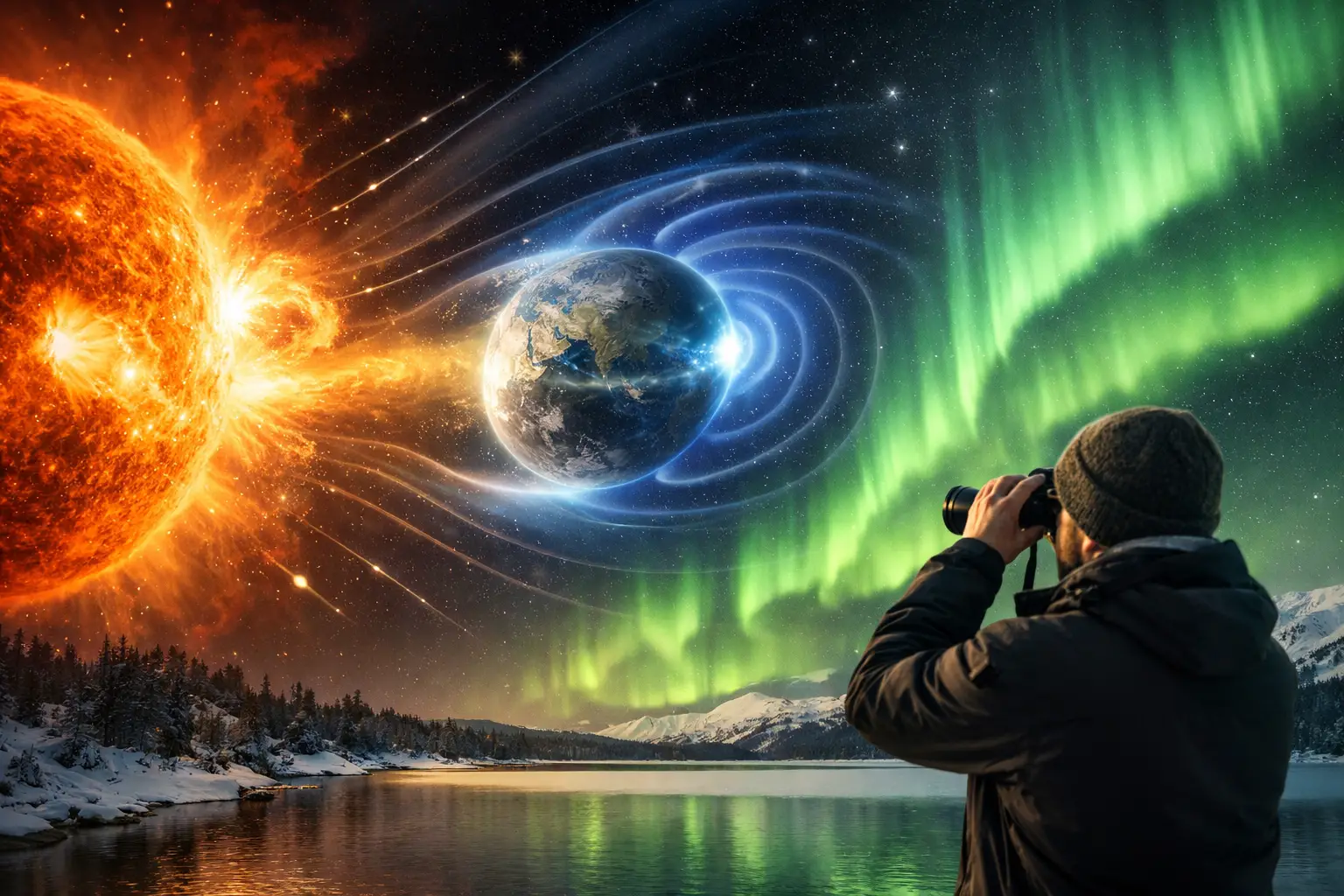
On May 10-11, 2024, a G5 geomagnetic storm pushed auroras far beyond their usual northern zone, with cameras and observers capturing color across much of the United States. That event made one fact impossible to miss: space weather is not distant science news. It can change the sky above your backyard, disrupt radio signals, and create a live observing opportunity with very little warning.
The action starts 93 million miles, or 149.6 million kilometers, away at the Sun. Here are the numbers that matter when you are tracking an incoming solar event.
| Space weather signal | Key measurement | What it can mean for observers |
|---|---|---|
| Solar flare | C, M, or X class; each class is 10 times stronger than the last | Radio impacts can arrive at Earth in about 8 minutes |
| Coronal mass ejection, or CME | Typically 1-3 days from Sun to Earth | A direct hit can trigger an aurora-producing geomagnetic storm |
| Solar wind at L1 | Monitored about 1.5 million km sunward of Earth | Provides roughly 15-60 minutes of final warning before arrival |
| Geomagnetic storm | NOAA G1-G5 scale, broadly corresponding to Kp 5-9 | Higher levels can expand the aurora oval toward lower latitudes |
What Space Weather Actually Is
Space weather is the changing condition of the space environment driven mainly by the Sun. The Sun constantly releases charged particles called the solar wind. Most days, Earth’s magnetic field deflects much of that flow. But active regions on the solar surface can produce solar flares, fast particle storms, and huge eruptions of magnetized plasma called coronal mass ejections.
A solar flare is a burst of electromagnetic energy. Its light and X-rays travel at the speed of light, reaching Earth in about 8 minutes and 20 seconds. That is why a flare can affect high-frequency radio communication on Earth’s sunlit side almost immediately.
A CME is different. It is a moving cloud of solar material, often carrying its own magnetic field. If that cloud is aimed at Earth and its magnetic orientation couples efficiently with Earth’s field, it can shake the magnetosphere and power a geomagnetic storm. That interaction energizes oxygen and nitrogen high in the atmosphere, creating the aurora.
The key word is if. An X-class flare can look dramatic on a solar monitor without producing a major aurora in the United States. A CME must be Earth-directed, arrive with favorable magnetic conditions, and maintain enough speed and density to disturb Earth’s magnetic shield. This is why real-time forecasts matter more than a single flare headline.
The Alerts Worth Watching
NOAA’s Space Weather Prediction Center uses three public storm scales. They are not interchangeable, and knowing the difference helps you avoid chasing the wrong alert.
Radio blackout alerts run from R1 to R5. They are tied to solar-flare X-ray intensity. An M1 flare is associated with R1 conditions, M5 with R2, X1 with R3, X10 with R4, and X20 with R5. These alerts matter most to shortwave radio users, aviation operations, and anyone following a major solar flare in real time. They do not automatically predict an aurora.
Solar radiation storm alerts run from S1 to S5. They measure energetic protons, typically using a threshold above 10 MeV. S1 begins at 10 proton flux units, while S5 reaches 100,000 proton flux units. These storms are a serious operational concern for satellites and astronauts, but they are not the main score to use for an aurora plan.
For skywatchers, the headline number is the geomagnetic scale: G1 through G5. G1 begins at Kp 5, G2 at Kp 6, G3 at Kp 7, G4 at Kp 8, and G5 at Kp 9. Kp is a planetary index based on magnetic observations collected over 3-hour intervals. A Kp 5 can support auroras in northern-tier states under dark skies; stronger storms can bring the oval dramatically farther south. Local clouds, light pollution, moonlight, and the storm’s timing still decide whether you actually see anything.
Why the final hour can change everything
Forecasters can often identify an Earth-directed CME one to several days before it arrives. But the most useful detail, the orientation of the incoming magnetic field, becomes much clearer when solar-wind monitors sample it upstream from Earth near the L1 point.
Watch for a sustained southward interplanetary magnetic field, often displayed as negative Bz, along with elevated solar-wind speed and density. Solar wind commonly moves around 300-800 km/s, though fast CME-driven streams can exceed that range. A sharp rise in speed is exciting, but a southward Bz is often the difference between a merely active graph and a sky full of aurora.
How to Turn an Alert Into an Aurora Plan
Start with location, not just the storm level. An observer in northern Minnesota, Michigan’s Upper Peninsula, or northern Maine has a different threshold than someone in Missouri, Colorado, or Virginia. At lower latitudes, you may need to look north toward the horizon instead of expecting color overhead.
Set your alert displays to UTC, then convert carefully to local time. Geomagnetic conditions are commonly forecast in 3-hour UTC blocks, while the most visible aurora for a US observer usually needs darkness. A strong interval forecast for 18:00-21:00 UTC may occur before sunset in much of the continental US, while a 03:00-06:00 UTC interval can line up with evening or overnight viewing depending on your time zone and daylight saving time.
Give yourself a dark northern view. Move away from direct streetlights, find an open horizon, and let your eyes adapt for at least 20 to 30 minutes. The aurora can begin as a pale gray arc that a phone camera records as green or red. That is still a real aurora, not a camera trick: human night vision is simply less sensitive to faint color.
For photography, begin with a stable tripod, a wide lens, and a 2-10 second exposure. Keep the exposure short enough to preserve structure if the display brightens. A 10-second exposure may reveal faint color during a G1 or G2 event, while a bright G4-level display can require much less time. Use manual focus on a bright star or distant light before the action begins.
Solar Viewing Has One Nonnegotiable Rule
Never look at the Sun without a solar filter designed for direct visual viewing. Eclipse glasses and handheld viewers should meet the ISO 12312-2 standard. Regular sunglasses, smoked glass, exposed film, and improvised filters are unsafe.
The same caution applies to cameras, binoculars, and telescopes. Magnification concentrates sunlight intensely. A properly rated solar filter must cover the front opening of the instrument, not sit at the eyepiece. If you are watching active regions that may produce flares, use a safe solar setup or rely on live solar imagery rather than risking eye damage.
Build a Better Live Space Weather Routine
Treat solar activity like launch tracking: watch the sequence, not one isolated data point. First, note a flare and whether it came from an Earth-facing active region. Next, check whether a CME was detected and modeled as Earth-directed. Then, when the expected arrival window approaches, monitor upstream solar-wind conditions and the Kp forecast.
Coronal holes are worth tracking too. They can send fast solar-wind streams that return roughly every 27 days as the Sun rotates. These events are often less explosive than CME impacts, but they can create recurring G1 or G2 activity and excellent aurora chances for observers already near the usual auroral zone.
A forecast is a launch window, not a guarantee. Keep your gear charged, use live cloud cover to choose the clearest direction, and check the sky even when the numbers are only moderately favorable. The next aurora may begin as a faint northern glow, then turn into the moment everyone wished they had stepped outside for.