
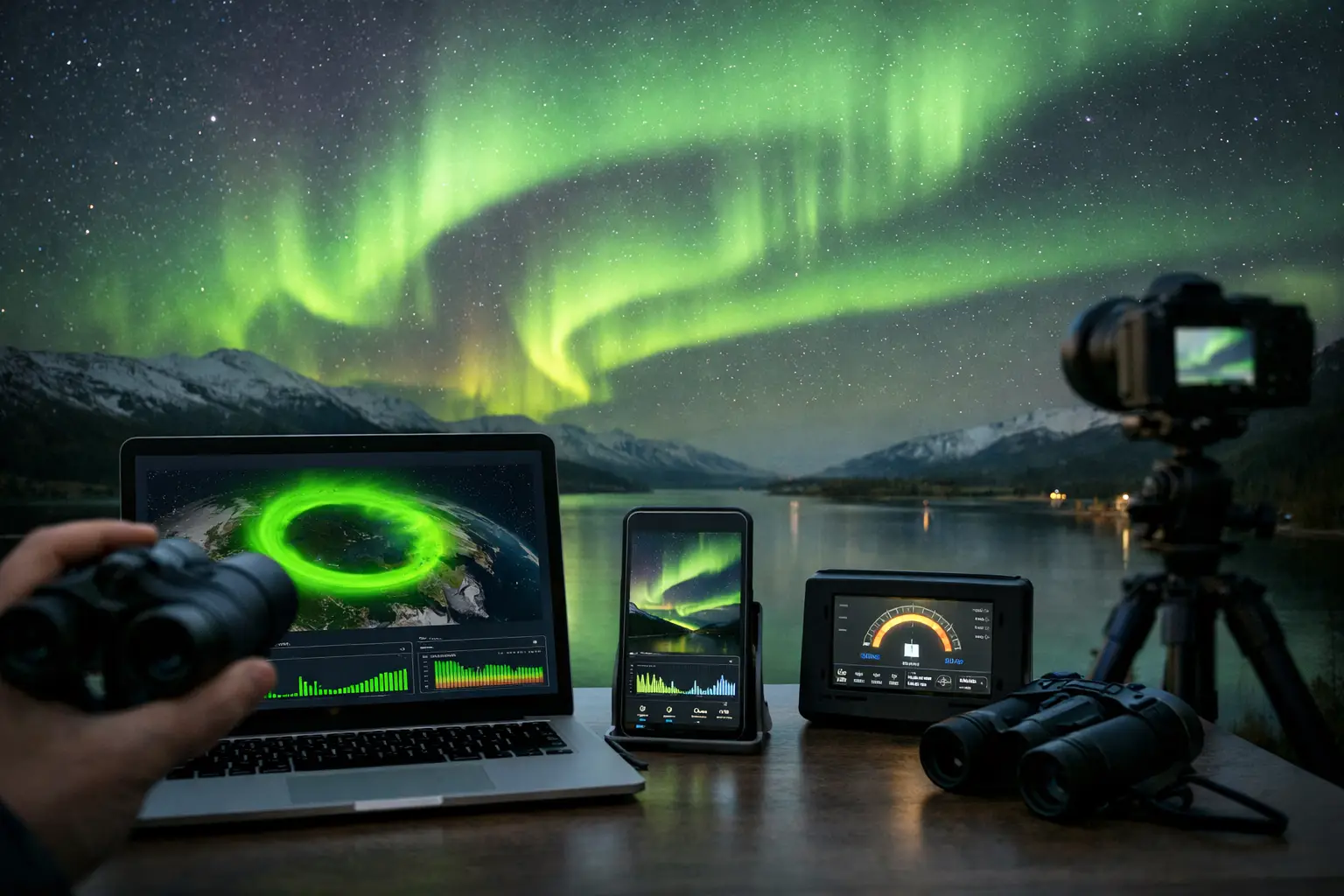
The question is not simply, “can you see aurora tonight?” It is whether space weather, your latitude, darkness, and local clouds will line up during the same narrow viewing window. A strong geomagnetic storm above a cloudy city is a missed show. A modest storm under clear skies in northern Minnesota can become an unforgettable one.
For the night of August 6, 2026, start with live conditions rather than a single aurora map. Solar wind conditions can shift in minutes, while the best viewing window depends on your exact horizon and local twilight. Use this mission-control checklist before you leave the house.
| Signal | Useful target | Why it matters |
|---|---|---|
| Planetary Kp index | Kp 5+ for broad U.S. interest | Kp 5 is NOAA G1 storm level; higher values push the auroral oval farther south. |
| IMF Bz | Below 0 nT, ideally -10 nT or lower | A southward Bz helps solar wind energy couple into Earth’s magnetic field. |
| Solar-wind speed | 500+ km/s is encouraging | Faster wind can increase geomagnetic activity, especially with a negative Bz. |
| Cloud cover | Under 30% | Aurora occurs roughly 90 to 300 km above Earth, but clouds still block every bit of it. |
Can You See Aurora Tonight From Your State?
There is no universal Kp number that guarantees an aurora sighting in every state. At Kp 3 or 4, observers in northern Alaska and parts of northern Canada may have a real opportunity, while most of the continental United States will not. At Kp 5, the northern tier becomes the main target zone: northern Washington, Montana, North Dakota, Minnesota, Wisconsin, Michigan, and Maine should watch closely when skies are clear.
At Kp 6, classified as a G2 geomagnetic storm, the viewing line can move farther south. The aurora may become possible from parts of Oregon, Idaho, Wyoming, Iowa, northern Illinois, upstate New York, and New England. At Kp 7, a G3 storm, cameras can often record the display well south of where it is obvious to the unaided eye. Reports from states near 40 degrees north latitude become more plausible, but they still depend on the storm’s timing and intensity.
The key word is possible. A Kp reading is a three-hour global index, not a personal forecast for your driveway. A sudden substorm can make the northern sky brighten for 10 to 30 minutes, then fade before the next Kp update. That is why live solar-wind data and short-term aurora forecasts are more useful than treating a single Kp value as a final answer.
Read the Live Space-Weather Signals
The solar wind takes roughly 30 to 60 minutes to travel from the L1 monitoring point to Earth, so the readings have practical near-real-time value. Start with Bz, measured in nanoteslas (nT). When Bz turns southward, below 0 nT, it creates a more favorable magnetic connection with Earth. A sustained Bz near -10 nT is a strong attention signal, especially if solar-wind speed is above 500 kilometers per second.
Density matters too. A jump in solar-wind density, measured in particles per cubic centimeter, can trigger a quick response even if the speed is only moderate. Think of it as a compressed gust hitting Earth’s magnetic shield. The combination to watch is not one perfect number, but a sustained period of fast wind, negative Bz, and rising geomagnetic activity.
NOAA’s storm scale gives useful context. G1 corresponds to Kp 5, G2 to Kp 6, G3 to Kp 7, G4 to Kp 8, and G5 to Kp 9. The jump from Kp 5 to Kp 7 is significant because the auroral oval can expand hundreds of kilometers toward lower latitudes. But even during a G3 event, clear skies and a dark northern horizon remain non-negotiable.
Build Your Best Viewing Window
For most U.S. observers, the most productive window is often between 10:00 p.m. and 2:00 a.m. local time. That is not a rule of nature, and aurora can appear at any dark hour. It is a practical planning window because the sky is usually fully dark and local observers are more likely to catch a midnight-sector enhancement.
Wait until the Sun is at least 12 degrees below the horizon, known as nautical twilight, for a meaningful check. At 18 degrees below the horizon, astronomical twilight ends and the sky reaches its darkest standard condition. In August, that distinction matters sharply across northern states, where evening twilight can linger. Alaska also faces a seasonal trade-off: excellent auroral latitude does not always mean enough darkness in late summer.
Move away from direct lights and face north. You do not need wilderness, but you do need a clear view from northwest through northeast. A hill, lakeshore, farm road, or open park can outperform a backyard hemmed in by trees and streetlights. Give your eyes 20 minutes to adapt, and keep your phone screen dim and red-tinted if possible.
Aurora at lower latitudes may not look like the vivid green photos shared online. It can begin as a pale gray arc or a faint vertical band near the horizon. Your camera sensor is more sensitive to color than your eyes, so take a test image even when the sky looks uncertain.
Use Your Phone Camera as an Aurora Detector
A recent smartphone in Night mode can reveal weak aurora that is hard to see visually. Brace the phone against a car roof, tripod, fence post, or small mount. Use the rear camera, turn off flash, and give the exposure several seconds if your device allows it. Avoid zooming digitally, which adds noise and reduces the chance of recording faint structure.
For a dedicated camera, begin with a wide lens between 14 and 24 mm, an aperture of f/1.4 to f/2.8, ISO 800 to 3200, and a 2- to 10-second exposure. A brighter, fast-moving display needs shorter exposures to preserve rays and curtains. A faint stationary arc may benefit from a longer exposure, but do not go so long that stars trail or aurora detail smears.
Take repeat images every few minutes. The difference between two frames can reveal movement your eyes missed, and it creates a useful record if the show suddenly intensifies.
The Fast Decision Before You Go
If the forecast shows clear skies, darkness has arrived, and Kp is at least 5 with negative Bz, go outside. If you are in the northern tier, do not wait for a dramatic red alert before checking the sky. Many worthwhile displays are brief, subtle, and visible only as a low greenish arc through a camera.
If Kp is lower but you live in Alaska, northern Minnesota, Michigan’s Upper Peninsula, northern Wisconsin, or Maine, check anyway. Latitude gives you a major advantage. If you live farther south, wait for a verified G2 or G3-level event, then prioritize a dark northern horizon and a camera-ready setup.
Keep the live dashboard open, watch the clouds, and give the northern sky a few patient minutes. The aurora does not follow a schedule, but when the numbers turn favorable, you can be ready before the next burst of light reaches the sky.