
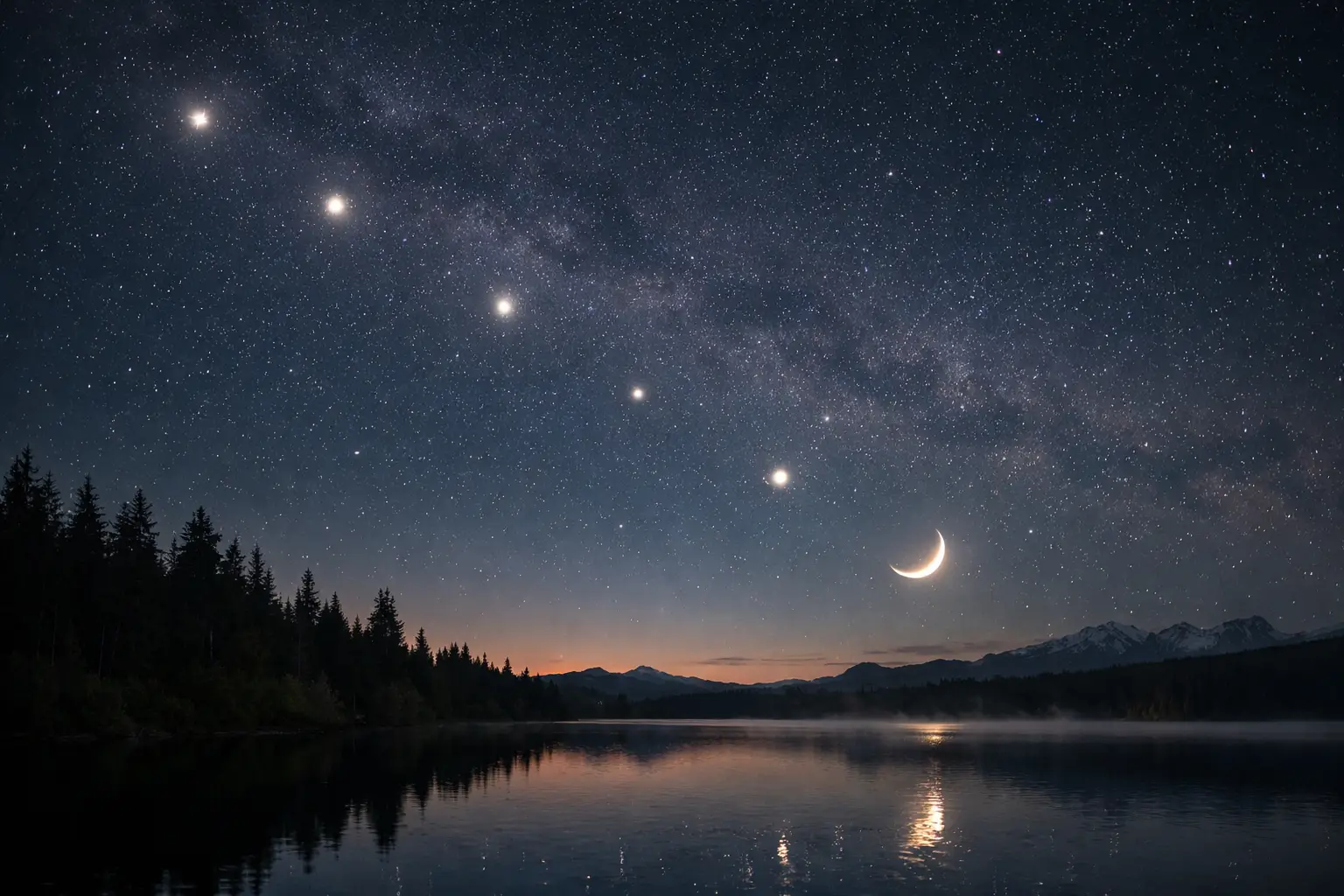
If you’re heading outside for a planetary alignment visible tonight, the first thing to know is this: most so-called alignments are not a straight-line sky spectacle. What you are actually tracking is a shared appearance of multiple planets along the ecliptic – the Sun’s apparent path across the sky – usually clustered before sunrise or after sunset. That still makes tonight worth watching, but timing and horizon clearance matter far more than hype.
| Object | Best viewing window | Approx. altitude | Direction | Visibility |
|---|---|---|---|---|
| Mercury | 30-45 min after sunset or before sunrise | 5-12 degrees | W or E horizon | Difficult, low horizon target |
| Venus | Up to 90 min from twilight | 10-25 degrees | W after sunset or E before sunrise | Very bright, easy |
| Mars | 1-3 hours after sunset or before dawn | 15-45 degrees | SE, S, or W depending on date | Moderate, reddish point |
| Jupiter | 1-4 hours when above 20 degrees | 20-60 degrees | E, S, or W depending on date | Very bright, easy |
| Saturn | 1-3 hours in darker sky | 15-40 degrees | E, S, or W depending on date | Steady yellow-white point |
What “planetary alignment visible tonight” really means
In astronomy coverage, alignment usually means several planets are visible in the same broad arc of sky, not stacked tightly together. Because the planets orbit in nearly the same plane, they appear along the same celestial track. That is why Mercury, Venus, Mars, Jupiter, and Saturn often look like they are tracing a line across dawn or dusk.
The trade-off is that visibility can vary wildly by location. A planet sitting 6 degrees above the horizon in Phoenix may be hidden by haze or buildings in Chicago. For most US observers, any object below 10 degrees altitude is vulnerable to atmospheric extinction, meaning it looks dimmer and may vanish into bright twilight.
Best way to check tonight’s alignment from the US
There is no single national answer that works for every city, because sunset, sunrise, and local horizon shape change the viewing window. For a practical US check, use this sequence.
First, determine whether tonight’s alignment is an evening event or a predawn event. If the inner planets are involved, Mercury and Venus usually force a narrow window close to sunset or sunrise. Second, look for the brightest anchor planet. Venus is the easiest when present. Jupiter is the next best starting point because it outshines almost every star. Third, scan along the ecliptic rather than searching randomly.
A good baseline for most locations in the continental US is to start observing 35 minutes after local sunset for evening alignments, or 50 minutes before local sunrise for morning alignments. Those numbers are practical because they balance darker sky against the risk of the lowest planet setting or getting lost in dawn glare.
| US time zone | Suggested evening start | Suggested morning start | Low-planet cutoff |
|---|---|---|---|
| Eastern | 35 min after local sunset | 50 min before local sunrise | Below 10 degrees is challenging |
| Central | 35 min after local sunset | 50 min before local sunrise | Below 10 degrees is challenging |
| Mountain | 35 min after local sunset | 50 min before local sunrise | Below 10 degrees is challenging |
| Pacific | 35 min after local sunset | 50 min before local sunrise | Below 10 degrees is challenging |
What you can realistically see with your eyes
This is where expectations matter. If headlines promise six planets, you may not see six planets from a suburban driveway with the naked eye. In real conditions, Jupiter and Venus are the easiest. Mars is usually visible if it is reasonably high and not too faint in its orbital cycle. Saturn can be subtle in twilight. Mercury is the usual problem child because it hugs the horizon.
Uranus and Neptune are sometimes counted in alignment graphics, but that does not mean they are easy targets. Uranus can reach about magnitude 5.7 under favorable conditions, which is technically near naked-eye range, but that requires dark skies and excellent vision. Neptune, around magnitude 7.8 to 8.0, requires binoculars or a telescope.
So if you are asking whether the planetary alignment visible tonight will look like a dramatic social media render, the honest answer is no. If you are asking whether you can step outside and track multiple worlds in one sweep of sky, absolutely yes – and that is still a great observing session.
Planet brightness and distance change the experience
Brightness is not just about planet size. It is a mix of distance, cloud cover, phase, and position relative to Earth and the Sun. Venus can shine near magnitude -4.0 or brighter, which is why it punches through twilight. Jupiter often ranges near magnitude -2.0. Mars swings a lot more depending on where it is in orbit. Mercury also changes quickly and is often stuck low.
Distance helps explain why the view feels uneven.
| Planet | Typical distance from Earth when observed | Typical visual clue | Best tool |
|---|---|---|---|
| Mercury | 77-222 million km | Low, pale point in twilight | Naked eye or binoculars |
| Venus | 38-261 million km | Extremely bright beacon | Naked eye |
| Mars | 56-401 million km | Reddish, steady light | Naked eye or telescope |
| Jupiter | 588-968 million km | Bright white giant | Naked eye or binoculars |
| Saturn | 1.2-1.7 billion km | Soft yellow-white point | Naked eye or telescope |
Those ranges are broad because planetary positions change constantly. On any given date, your real target is not the abstract distance but whether the planet is high enough above your horizon to clear haze and rooftops.
How to spot the alignment fast
If you want a quick mission plan, go somewhere with an unobstructed eastern or western horizon and arrive 10 minutes early. Let your eyes adjust. Keep your phone screen dim. Start with the brightest object, then trace upward or sideways along the same arc.
Binoculars help, especially 7×50 or 10×50 models, but they are not always required. They become useful when Mercury or Saturn is faint in twilight, or when you are trying to confirm Uranus. Do not sweep binoculars near the Sun. If you are observing in the morning, wait until the Sun is fully below the horizon before using optics.
For families and casual observers, the easiest win is to identify two bright planets and explain why they share the same path. For enthusiasts, the fun jumps when you compare color, brightness, and separation over several nights. Alignments are not one-night-only magic tricks. They are moving geometry.
Planetary alignment visible tonight: common obstacles
Cloud cover is obvious, but thin haze near the horizon is just as destructive. A planet at 7 degrees altitude can disappear even under a forecast labeled mostly clear. Light pollution is less damaging to Venus and Jupiter than people expect, but it can wipe out Mercury and Saturn when they are low.
The Moon can also change the session. A bright waxing gibbous or full Moon reduces contrast, especially for fainter planets and nearby stars that help you orient yourself. On the other hand, a crescent Moon near the alignment can make the scene much easier to locate and far more photogenic.
Another issue is date drift. A social post about a planetary event may still be circulating days after the best configuration. In a fast-moving sky setup, a difference of 48 to 72 hours can noticeably change spacing, altitude, and visibility. That is why live sky tools matter more than viral screenshots.
Is tonight worth it if only three planets are obvious?
Yes. Three planets in one sky window is already a strong observing event, especially if one is Venus or Jupiter and another is Mars or Saturn. The phrase alignment gets used loosely, but the real value is seeing orbital mechanics play out in real time from your own location.
That is also the better mindset for beginners. You are not failing if Mercury stays hidden in twilight or if Uranus needs binoculars. You are tracking worlds across tens of millions to billions of kilometers, using nothing more than a darkening sky and a good horizon.
If tonight looks marginal, give yourself 20 minutes and check anyway. Planet watching rewards persistence more than perfection, and the best alignment is often the one you actually catch before the clouds roll in.