
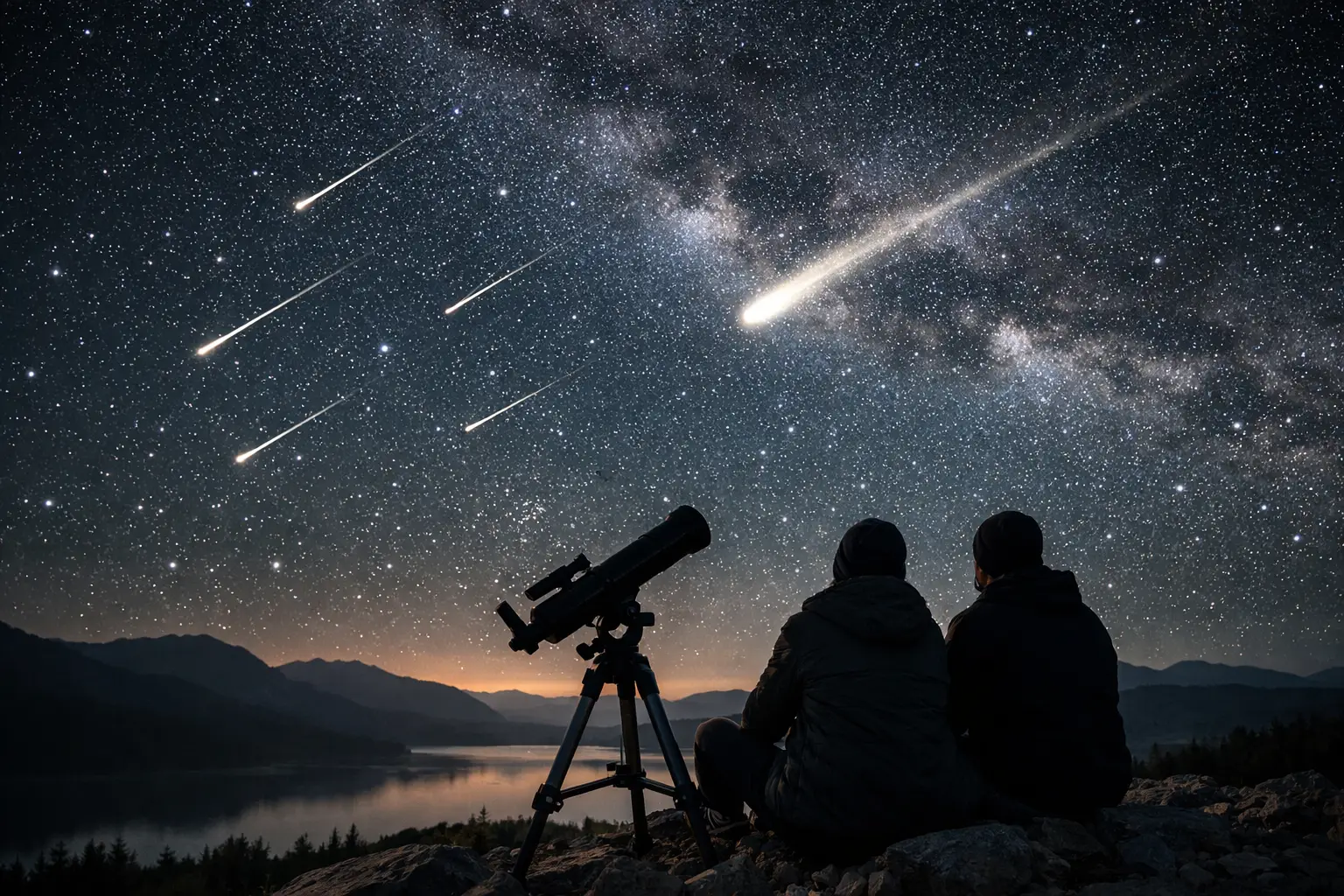
If you’re planning around a meteor shower peak tonight, the difference between seeing two streaks and catching a real sky show usually comes down to timing, moonlight, and where the radiant sits above your horizon. Tonight’s peak matters because meteor activity is not evenly spread across the night. Rates typically build after local midnight, then climb toward the pre-dawn hours as your side of Earth turns into the stream of debris.
| Viewing factor | Best range | Units | Why it matters |
|---|---|---|---|
| Peak observing window | 2:00 a.m. to 5:00 a.m. | Local time | Usually the strongest activity for most major annual showers |
| Recommended dark-sky distance | 30 to 60+ | miles from city center | Cuts skyglow enough to reveal fainter meteors |
| Typical meteor burn-up altitude | 80 to 120 | km | Shows where the visible streak actually forms in the upper atmosphere |
| Typical meteor speed | 40,000 to 260,000 | km/h | Faster showers produce shorter, sharper streaks |
What “meteor shower peak tonight” actually means
A peak is the period when Earth is crossing the densest part of a meteoroid stream. That does not mean the sky flips on at one exact minute for every location in the US. Peak timing is usually published in UTC, and your local best view depends on whether that peak lands before midnight, after moonrise, or during the stronger pre-dawn hours.
For US observers, converting the published peak matters. As a quick reference, 06:00 UTC equals 2:00 a.m. EDT, 1:00 a.m. CDT, 12:00 a.m. MDT, and 11:00 p.m. PDT on the previous calendar date. If a shower peaks at 12:00 UTC, that becomes 8:00 a.m. EDT and 5:00 a.m. PDT, which can put eastern observers into daylight while western states still have a short dark window.
Best time to watch the meteor shower peak tonight
If you only have one window, target roughly 2:00 a.m. to 5:00 a.m. local time. That is the most reliable rule for major annual showers because your location is then rotating into the direction of Earth’s orbital motion, which boosts the number of particles hitting the atmosphere above you.
Early evening can still produce meteors, especially bright earthgrazers, but hourly counts are usually lower. If the official peak lands in the evening, you should still go out later if skies stay clear. Meteor showers often maintain elevated rates for several hours on either side of the listed maximum.
Why after midnight usually wins
Before midnight, you are effectively on the trailing side of Earth. After midnight, you move onto the leading side, so more meteoroids meet the atmosphere head-on. That geometry is why a shower with a theoretical zenithal hourly rate of 60 rarely looks impressive at 10:00 p.m. from a suburban backyard, yet can become active by 3:30 a.m. under darker skies.
Where to look during the meteor shower peak tonight
Do not stare directly at the radiant. The radiant is the point in the sky where the meteors appear to originate, but the longest and most dramatic streaks often show up 30 to 60 degrees away from it. A good tactic is to recline and watch a broad section of sky halfway up from the horizon.
If the shower’s radiant is low, activity will look weaker. If it climbs high before dawn, your counts improve. For many well-known showers, the radiant reaches a more favorable altitude after midnight and is significantly better by 4:00 a.m.
| US time zone | Strongest default watch window | Units | Viewing note |
|---|---|---|---|
| Eastern | 2:00 a.m. to 5:00 a.m. | EDT or EST | Best for most observers if moonlight is limited |
| Central | 2:00 a.m. to 5:00 a.m. | CDT or CST | Often catches the sweet spot for internationally timed peaks |
| Mountain | 2:00 a.m. to 5:00 a.m. | MDT or MST | Dark western skies can make faint meteors easier to catch |
| Pacific | 1:00 a.m. to 4:30 a.m. | PDT or PST | Can benefit when UTC peak times shift late for North America |
The biggest factors that can ruin or rescue tonight’s show
Moonlight is the first thing to check. A bright gibbous or full Moon can erase many fainter meteors, cutting visible rates sharply even if the shower itself is strong. If the Moon is up tonight, place it behind a tree line, building, or hill and watch the opposite side of the sky.
Cloud cover is the obvious second factor, but haze and humidity matter too. Thin high cloud can wipe out the faint half of a shower while still leaving brighter stars visible, which tricks a lot of observers into thinking conditions are fine. Transparency counts.
Light pollution is the third major variable. In a bright suburb you may only catch the top 10 to 20 percent of the shower’s meteors. Under a darker rural sky 30 to 60 miles from heavy urban lighting, the same shower can feel much more active.
How many meteors can you expect?
This is where expectations need calibration. Published rates often use zenithal hourly rate, or ZHR, which assumes a perfectly dark sky, the radiant overhead, and a trained observer. Real-world US counts are usually lower.
A shower advertised at 100 meteors per hour does not mean every backyard observer will see 100. In practice, many people under decent but not pristine skies might log 15 to 40 per hour. Under dark, moon-free conditions near the best local time, stronger showers can absolutely outperform that. But if the radiant is low or the Moon is bright, the gap between theoretical and observed rates can be huge.
Meteor shower peak tonight and realistic viewing counts
If conditions are excellent, expect a meteor every few minutes during an active shower. If conditions are average, expect uneven bursts separated by lulls. That stop-and-start rhythm is normal. The sky is not malfunctioning – meteor streams are patchy.
Gear you actually need
Keep it simple. Your eyes are the main instrument. Binoculars and telescopes narrow the field too much for meteor watching.
The useful setup is a reclining chair, warm layers, a red-light flashlight, and at least 30 minutes for your eyes to dark-adapt. Bring a blanket even in summer. Standing still for an hour under clear skies feels colder than most forecasts suggest.
If you want photos, use a wide-angle lens, a tripod, and repeated exposures of 10 to 20 seconds depending on focal length and sky brightness. In bright moonlight or suburban glow, shorter exposures can keep the sky from washing out. A lot depends on your camera sensor and how noisy it gets at higher ISO settings.
A better plan for families and casual observers
If you’re heading out with kids or first-time skywatchers, do not overpromise a nonstop fireworks display. Frame it as a one-hour watch window with the chance of several fast, bright streaks. That keeps the experience fun even when the shower underdelivers.
Aim for a site with an open horizon, safe parking, and minimal nearby lighting. Give everyone one job: one person watches north, one south, one overhead. It sounds simple, but it works. Group viewing boosts your odds of catching more meteors and makes the quiet stretches feel shorter.
What makes meteor showers so fast and bright
The particles are usually tiny – often no bigger than grains of sand or small pebbles. They light up because of extreme speed, not size. Depending on the shower, they can slam into the atmosphere at tens of thousands to more than 200,000 km/h and start glowing roughly 120 km up, often fading by around 80 km altitude.
That also explains why a brief streak can be visible over a huge area. Two people 50 miles apart may both see the same bright meteor, especially a fireball. If you catch one tonight, remember you’re watching a tiny fragment of cometary or asteroidal debris turn kinetic energy into a flash above the weather, the jets, and almost all of the atmosphere.
For tonight, the smart move is simple: check the forecast, target the 2:00 a.m. to 5:00 a.m. window, get away from city glow, and give the sky enough time to surprise you. The best meteor nights rarely feel dramatic at the start, then suddenly one bright streak tears across the dark and everyone is fully awake.