
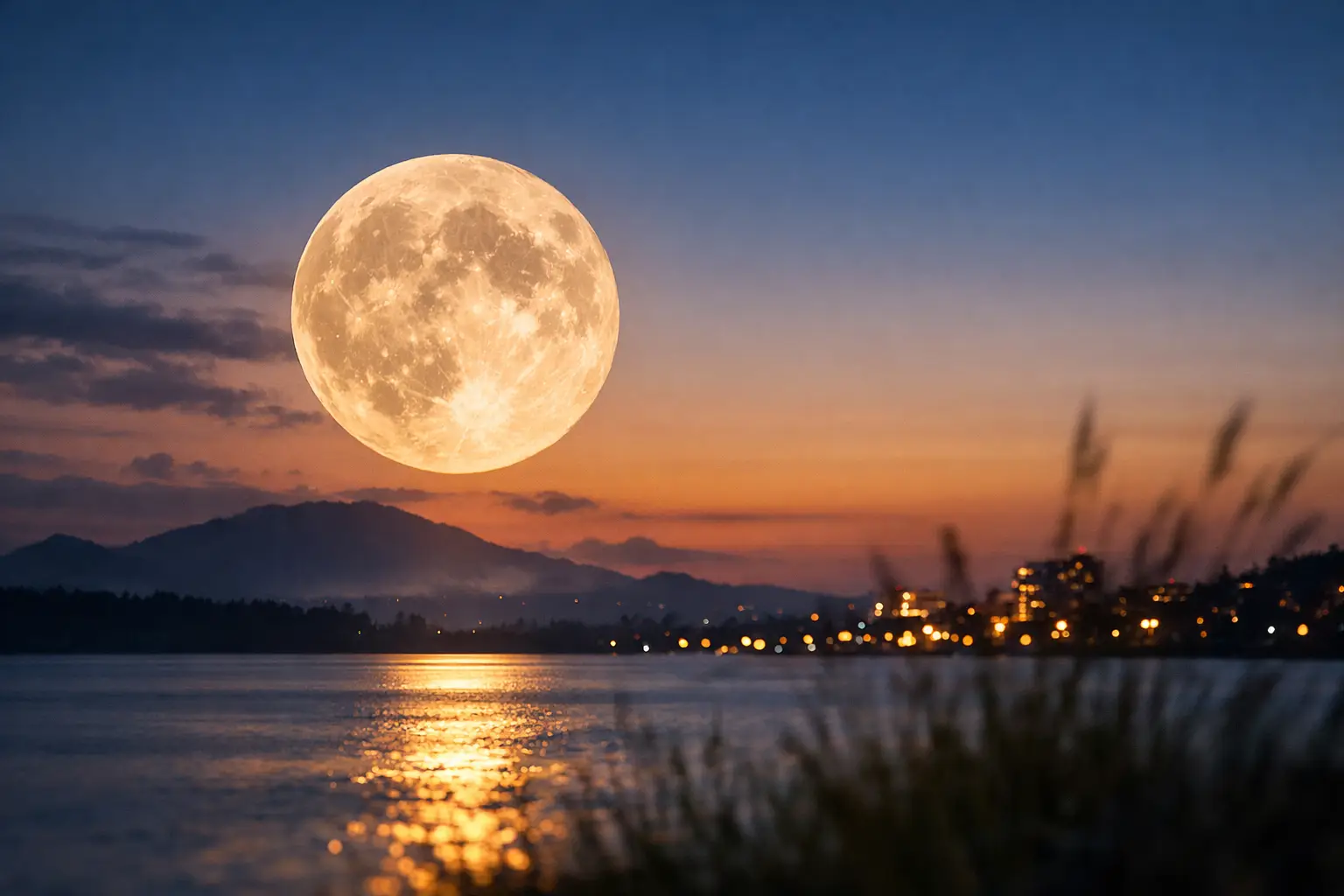
If you are checking your calendar and asking when is the next supermoon, the key date to mark is November 5, 2026. That is the closest full supermoon of the year, with the Moon reaching full phase at 13:19 UTC and sitting roughly 356,980 km from Earth near perigee. For US skywatchers, that puts the best visual window on the evening of November 4 into the early hours of November 5, depending on your time zone and local weather.
| 2026 supermoon | Full Moon peak (UTC) | Approx. distance to Earth (km) | US evening visibility |
|---|---|---|---|
| October 7, 2026 | 03:47 UTC | ~357,200 km | Evening of Oct. 6 |
| November 5, 2026 | 13:19 UTC | ~356,980 km | Evening of Nov. 4 and Nov. 5 |
| December 4, 2026 | 23:14 UTC | ~357,600 km | Evening of Dec. 4 |
That short answer helps if you just want the headline date. But if you are planning a photo session, a family viewing night, or a horizon-rise watch, the better question is not only when is the next supermoon, but which supermoon gives you the best experience from your location.
When is the next supermoon and why that date matters
A supermoon happens when a full Moon occurs close to perigee, the point in the Moon’s orbit where it is nearest to Earth. Because the Moon’s orbit is elliptical, that distance changes every month. At apogee, the Moon can be more than 405,000 km away. Near perigee, it can drop to around 357,000 km. That difference is large enough to make the full Moon appear noticeably bigger and brighter than a more distant full Moon, especially in photos and during moonrise.
For 2026, the supermoon sequence is centered in the fall. The standout event is the November 5 full Moon, because it arrives extremely close to perigee. October 7 and December 4 are also strong supermoon candidates, and many skywatching guides will treat all three as the main supermoons of the year.
The catch is that the Moon does not suddenly look huge at the exact peak minute. Full phase is an instant, but the Moon appears essentially full for about a day on either side. That gives US observers a much bigger viewing window than the UTC timestamp alone suggests.
2026 supermoon dates for US skywatchers
If your goal is practical planning, these are the dates to watch. The times below are the full Moon peaks in UTC, followed by the equivalent US time where useful.
| Date | Peak time (UTC) | Peak time (US Eastern) | Approx. distance (km) |
|---|---|---|---|
| October 7, 2026 | 03:47 UTC | Oct. 6, 11:47 PM EDT | ~357,200 km |
| November 5, 2026 | 13:19 UTC | Nov. 5, 8:19 AM EST | ~356,980 km |
| December 4, 2026 | 23:14 UTC | Dec. 4, 6:14 PM EST | ~357,600 km |
November 5 is the one most observers will want to prioritize. It is the closest of the three and should rank as the biggest full Moon of 2026 by distance. October 7 is close behind, and December 4 still delivers a very strong oversized full Moon, even if it is not the absolute closest.
What counts as a supermoon, exactly?
This is where astronomy and popular usage split a little. There is no single official International Astronomical Union definition for “supermoon.” In public skywatching, the term usually means a full Moon that occurs within about 90 percent of its closest approach to Earth in a given orbit cycle. That broad rule is why different publications sometimes list three supermoons in a year and others list four.
For everyday viewing, the distinction is less dramatic than the headlines make it sound. Even a top-tier supermoon does not look twice as big as a normal full Moon. Compared with a full Moon near apogee, a supermoon can appear roughly 12 to 14 percent larger in diameter and around 25 to 30 percent brighter. That is a real difference, but it is subtle overhead and much more striking near the horizon, where perspective and foreground objects amplify the effect.
Best time to watch the next supermoon in the US
The best supermoon viewing usually happens at moonrise, not at peak full phase. That is because a low Moon against buildings, trees, hills, or open water gives your eyes a size reference. It also tends to produce the most dramatic photography.
For the November 5, 2026 supermoon, many US observers will get their best view on the evening of November 4, when the Moon rises nearly full and very bright. Others may prefer the evening of November 5, when the Moon is just past full but still visually impressive. In both cases, the sweet spot is the first 30 to 90 minutes after moonrise.
Moonrise time changes by city, so local timing matters. In a typical US location, the full Moon around this season rises close to sunset, often within a window of about 10 to 40 minutes before or after sunset. If you want the most dramatic view, arrive at your observing site at least 20 minutes before local moonrise and pick a location with a clean eastern horizon.
How much bigger will the next supermoon look?
This is the part that benefits from realistic expectations. The November 2026 supermoon will be near 356,980 km from Earth. A more average full Moon sits around 384,400 km away. That is a difference of more than 27,000 km, which sounds huge because it is. Visually, though, your eye reads that as a moderate change, not a jaw-dropping transformation.
What you will notice most is brightness, color near the horizon, and the sense of scale when the Moon rises behind familiar landmarks. If thin haze or smoke is present, the Moon can also glow orange or deep gold near the horizon. That color is caused by Earth’s atmosphere scattering shorter wavelengths, not by the supermoon itself.
How to plan your supermoon watch
A little prep makes a big difference. Start with your local moonrise time and weather forecast. Then choose a site with an unobstructed eastern view, because a skyline or tree line can delay your first sighting by several minutes.
If you are shooting photos, use a tripod and plan your framing before the Moon appears. Smartphone cameras can capture the scene well if you include foreground objects, but they usually struggle with close-up lunar detail. For detail shots, a camera with a telephoto lens in the 200 to 600 mm range is far better.
Binoculars are excellent for casual observing. Even 8×42 or 10×50 binoculars will reveal darker maria, bright crater rays, and the crisp edge of the lunar limb. A small telescope gives you much more detail, but around full Moon the lighting is flat, so crater shadows are less dramatic than they are near first or last quarter.
Why supermoon rankings can vary
If you see one source call November 5 the year’s biggest supermoon and another source emphasize October 7, that does not automatically mean one is wrong. Different lists use slightly different cutoffs, and some rank by distance at full phase while others weigh the timing of perigee itself.
The practical takeaway is simple. October, November, and December 2026 all offer strong full-Moon events, but November 5 is the most widely defensible answer to when is the next supermoon if you want the closest and most headline-worthy full Moon still ahead in the 2026 calendar.
For the best result, treat the supermoon like a launch window, not a single minute. Watch the forecast, track local moonrise, and give yourself two evenings if clouds are a threat. The Moon will do its part right on schedule. Your job is just to be in the right place when it clears the horizon.