
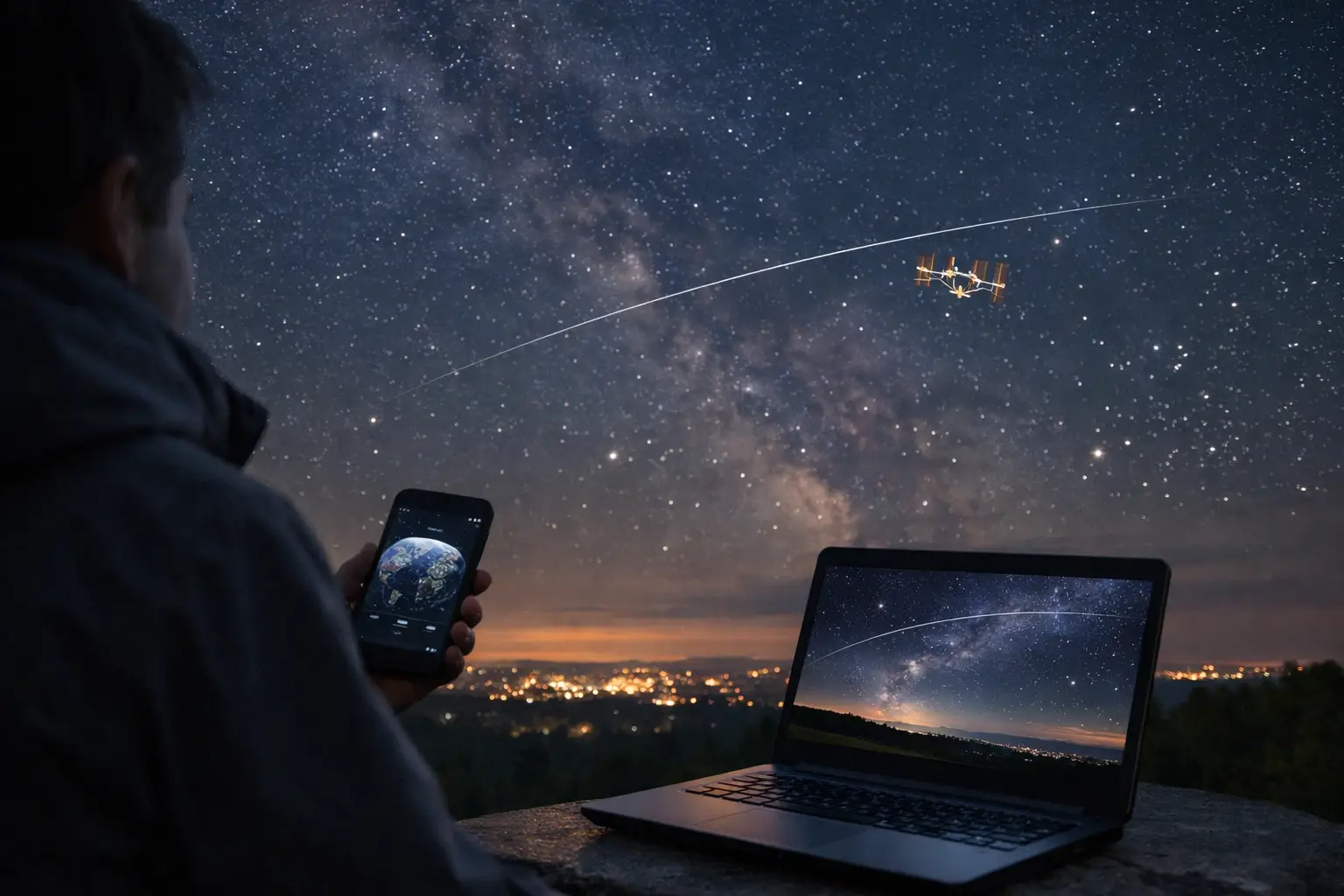
The International Space Station can cross your sky in less than 6 minutes, but that short window can be spectacular: a bright, steady point of light moving faster than most aircraft. The key to how to track ISS tonight is not finding a generic schedule. It is using a live prediction calibrated to your exact location, then checking whether the station will be high enough, bright enough, and above a clear part of the sky.
| ISS tracking figure | Typical value | Why it matters tonight |
|---|---|---|
| Orbital altitude | About 408 km (254 mi) | The station is close enough to appear bright when sunlight reaches it. |
| Orbital speed | About 27,600 km/h (17,150 mph) | A visible pass is brief, often 2 to 6 minutes. |
| Orbital inclination | 51.6 degrees | The ISS can be seen from much of the United States, but not on every orbit. |
| One orbit | About 92.9 minutes | Pass opportunities shift rapidly from one evening to the next. |
For the date of July 11, 2026, do not assume a sighting listed for another city or another time zone applies to you. An ISS pass that peaks at 70 degrees above the horizon in Chicago may skim only 15 degrees high from a location several hundred miles away. Live orbital data and an accurate observing location turn a possible sighting into a real plan.
How to track ISS tonight in three minutes
Start with a live ISS tracker and enter your city, ZIP code, or precise map location. Location accuracy matters because the station travels roughly 7.7 km per second, and the local horizon changes the beginning, peak, and end of every pass. A prediction should show at least the start time, end time, maximum altitude, compass direction, and estimated brightness.
Use the displayed local time, not UTC, unless you are deliberately working in UTC. In summer, U.S. observers are usually on daylight saving time: Eastern Daylight Time is UTC-4, Central Daylight Time is UTC-5, Mountain Daylight Time is UTC-6, and Pacific Daylight Time is UTC-7. A tracker should handle that conversion automatically, but check the time-zone label before heading outside.
Next, focus on the highest pass rather than simply the earliest one. Maximum altitude is measured in degrees above your horizon. Zero degrees is the horizon, 45 degrees is halfway to straight overhead, and 90 degrees is directly overhead. For a first-time observer, a pass peaking above 40 degrees is a strong target. Above 60 degrees is excellent because trees, homes, haze, and city glow interfere far less.
Finally, open a sky map or compass view before the pass begins. If the prediction says the ISS rises in the northwest and reaches its highest point in the northeast, you know where to face. That single step prevents the classic missed pass: staring south while the station has already crossed behind you.
The numbers worth checking
A practical tracker gives you more information than a countdown. Use these thresholds to decide whether to go outside:
- Maximum altitude: 40 degrees or higher is worth prioritizing. Passes below 20 degrees can still be visible, but buildings and atmospheric haze often win.
- Duration: 3 minutes is a useful minimum for casual viewing. A 5- or 6-minute pass gives you time to find it and share the moment.
- Brightness: Negative magnitude numbers are brighter. An ISS prediction near magnitude -3 is exceptionally bright, while magnitude 0 is still easy to see under reasonably dark skies.
- Sun elevation: The best passes occur after sunset or before sunrise, when your sky is dark but the station, hundreds of kilometers above, remains sunlit.
The exact brightness changes with the station’s angle to the Sun and your position on Earth. Treat the magnitude estimate as a planning signal, not a laboratory measurement.
Why the ISS is visible after sunset
The ISS does not carry a searchlight visible from the ground. You see sunlight reflecting from its large solar arrays and modules. That creates a narrow but reliable viewing zone around local dawn and dusk: observers are in darkness or twilight while the station is still in direct sunlight.
The useful window often begins about 15 to 90 minutes after sunset or before sunrise, though local geometry decides the exact timing. A pass can also fade suddenly mid-flight when the ISS enters Earth’s shadow. If it dims smoothly and disappears while still high in the sky, that is usually an orbital sunset, not a cloud or equipment problem.
This is why an all-night tracker is less useful than a pass predictor. The station may orbit above your region during the middle of the night, but it will be invisible if both you and the ISS are in darkness.
Read the pass path before you step outside
Every prediction has three moments: rise, peak, and set. The rise is where the ISS first clears your local horizon. It may appear in the west, northwest, southwest, or occasionally another direction depending on the orbit. The peak is its greatest altitude. The set is when it drops below the horizon or enters shadow.
Be outside 5 minutes early. Give your eyes a few minutes away from bright indoor lights, then identify the direction of the rise with a phone compass or a fixed landmark. You do not need binoculars to see the station. In fact, binoculars make it harder to locate because the ISS moves quickly through a narrow field of view.
Look for a non-blinking white or slightly yellow-white light moving steadily. Aircraft usually show flashing red, green, or white navigation lights. Satellites can look similar, but the ISS is frequently much brighter and crosses a large stretch of sky in a few minutes. It will not stop, turn, or make a sound.
If your pass starts low
A 10- to 20-degree pass is not automatically a lost cause. It depends on your view. A beach, open field, hilltop, lakefront, or rooftop with a clear horizon can make a low pass easy to catch. In a neighborhood with tall trees, a 20-degree prediction may be blocked until the station has already reached its highest point.
Check the direction as carefully as the altitude. A 25-degree pass in an open western sky can outperform a 45-degree pass that peaks behind your apartment building. This is where a local sky view earns its place over a citywide schedule.
Weather, light pollution, and the reality check
The ISS is bright enough to see from many major U.S. cities, including heavily light-polluted areas. You do not need a dark-sky site. You do need a cloud break. Thin cirrus can soften the station but may still allow a sighting; low overcast or a thunderstorm deck will block it completely.
Before the pass, check cloud cover for the precise 10-minute period around the predicted peak. A forecast of 50% cloud cover does not mean half the sky is unusable in a helpful pattern. It means conditions are uncertain. If clouds are scattered, pick the clearest horizon in the direction of the predicted rise and keep watching.
Moonlight is usually not a deal-breaker. A bright Moon can reduce contrast for faint stars, yet the ISS often remains obvious. The bigger problem is glare from streetlights, porch lights, and phone screens. Stand in a shadowed spot and dim your screen once you have confirmed the route.
Make tonight’s sighting more than a flyby
If you are observing with children, call out the rise time and have everyone face the correct direction before the countdown reaches zero. If you are photographing, use a tripod, a wide-angle lens, and a multi-second exposure. A 5- to 15-second exposure can record the station as a bright line, but exposure settings depend on sky brightness, Moon phase, and camera type.
For a quick phone video, skip extreme zoom. Frame a wide section of sky and keep the phone steady against a railing, tripod, or solid object. The visual memory is often better than the footage, especially on a pass that climbs above 60 degrees and races overhead.
SpaceInformer’s live tracking tools are built for this exact moment: confirm the local path, launch your countdown, and step outside ready. The next visible ISS pass is not a distant space story. It is a 420-ton orbiting laboratory moving across your own sky at nearly 28,000 km/h.