
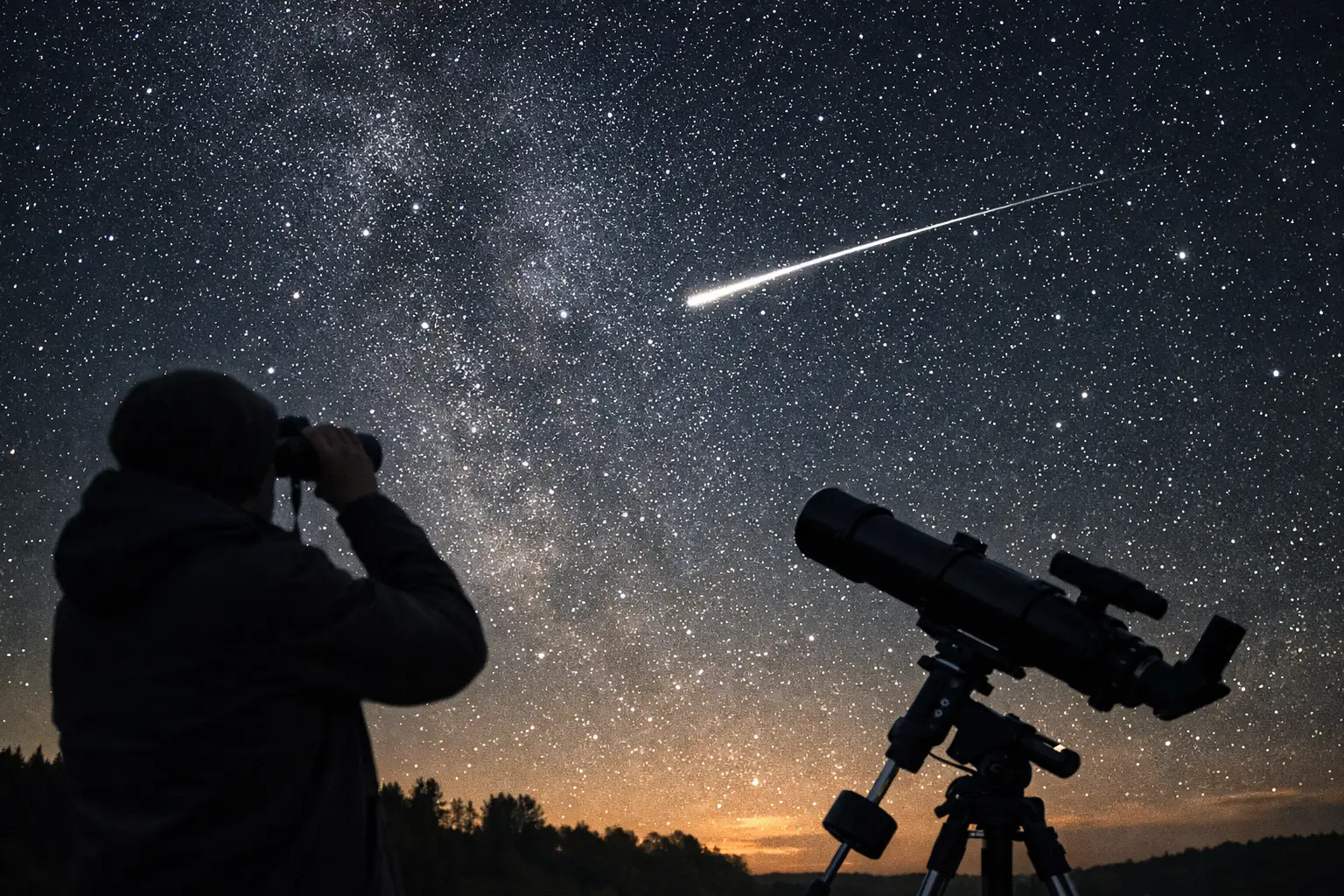
You do not need a telescope, a dark-sky ranch, or a degree in orbital mechanics to catch the International Space Station. You need timing, a clear slice of sky, and about 3 to 6 minutes of attention. This beginner guide to ISS spotting is built for exactly that moment – when a bright object rises fast, glides across the sky, and is gone before most people finish opening their camera app.
The ISS is one of the easiest human-made objects to see from the ground because it is huge by spacecraft standards and moves fast in low Earth orbit. It circles Earth at about 27,600 km/h, flies at roughly 370 to 460 km altitude depending on its current orbit, and can outshine every star in the sky except the Moon and bright planets. A good pass looks like a brilliant, steady white light moving smoothly from one horizon to another with no blinking lights and no visible exhaust trail.
| ISS spotting fact | Typical value | Unit |
|---|---|---|
| Orbital speed | 27,600 | km/h |
| Orbital altitude | 370-460 | km |
| Visible pass length | 3-6 | minutes |
| Best viewing windows | 1-2 hours after sunset or before sunrise | local time |
| Bright pass magnitude | -1 to -4 | visual magnitude |
How the beginner guide to ISS spotting works
The trick is simple: the sky over you must be dark enough, while the ISS is still high enough to catch direct sunlight. That geometry happens most often from about 30 to 90 minutes after sunset and 30 to 90 minutes before sunrise. At midnight, passes can still happen, but truly bright visible passes are less common because the station may also be in Earth’s shadow.
For most US observers, the best beginner strategy is to check passes for the next 10 days and look for a maximum altitude above 40 degrees. Lower passes near 10 to 20 degrees can still be visible, but haze, trees, buildings, and light pollution cut into your odds fast. A pass peaking above 60 degrees is much easier because the station climbs well clear of the horizon and stays bright longer.
What a good ISS pass looks like
A solid pass includes four pieces of data: start time, start direction, peak altitude, and end direction. If a tracker says the ISS appears at 9:14:30 PM local time in the northwest, peaks at 63 degrees at 9:17 PM, and disappears in the southeast at 9:20 PM, that is enough to plan the whole sighting. Be outside 2 minutes early. Face the starting direction. Then follow the motion as it climbs.
| Pass quality | Max altitude | Typical beginner experience |
|---|---|---|
| Poor | 0-20 | Easy to miss near haze and rooftops |
| Fair | 21-40 | Visible if you know exactly where to look |
| Good | 41-60 | Strong first-timer pass |
| Excellent | 61-90 | High, bright, and hard to miss |
Brightness matters too. The ISS is usually described with visual magnitude. A pass near magnitude -3 is dramatic even from suburban skies. Near magnitude 0, it is still visible, but not nearly as attention-grabbing. If you are choosing between two passes, take the brighter one unless the altitude is much lower.
Beginner guide to ISS spotting by direction and timing
Most people miss the station because they step outside on time instead of early. The station can cover a huge section of sky in minutes. If your listed appearance time is 8:51 PM, be outside by 8:48 PM with your eyes adjusted and your starting direction already fixed.
Direction is usually shown as compass points like WNW or SSE. If that feels technical, simplify it. West means where the Sun set. East is the opposite side. South is the arc of sky where the midday Sun travels. North is behind you when you face south. On your first few passes, broad directional awareness is enough.
Altitude is measured in degrees above the horizon. Zero degrees is the horizon. Forty-five degrees is halfway from the horizon to directly overhead. Ninety degrees is straight up. If a pass peaks at 75 degrees, the station will be nearly overhead. If it peaks at 18 degrees, you need a very open view.
A typical visible pass in the US might start low in the west at 10 degrees, rise to 52 degrees in the southwest after 2 minutes, then fade in the southeast at 24 degrees after another 2 minutes. That fade is normal. The station usually does not land, stop, or turn off. It enters Earth’s shadow and vanishes.
What you need and what you do not
For pure spotting, your eyes are the main tool. Binoculars can help after you learn the station’s path, but they make the first attempt harder because the ISS moves quickly. A telescope is even less beginner-friendly for initial sightings. It can show structure on a well-timed pass, but only if tracking is precise.
What does help is a live pass predictor tied to your exact location. Even a shift of 50 to 100 km can change the apparent track, peak altitude, and brightness. That is why local timing matters more than general national schedules. If you use a live tracking tool from a platform like SpaceInformer, check the pass time in your time zone, confirm the first visible direction, and pay attention to the listed maximum elevation.
Cloud cover is the biggest deal-breaker. Thin high clouds can still let a bright pass show through. Low clouds usually kill the view completely. Light pollution matters less than beginners expect because the ISS is bright. An urban backyard with a clear western sky can beat a dark rural site blocked by trees.
How to tell the ISS from planes and satellites
The ISS does not blink. Aircraft show navigation lights, often red and green, and they usually change brightness as they turn. The ISS shines with a steady white light. It moves faster than a typical high-altitude plane across the background stars, but not like a meteor. Meteors streak in a second or two. The ISS cruises.
Other satellites can fool you, especially if you are in a dark location. Many satellites are fainter and slower-looking because they are dimmer, not because they are actually moving much slower in orbit. The ISS usually stands out by brightness and confidence. Once you see one strong pass, the difference becomes obvious.
The best conditions for your first successful sighting
Aim for a pass within 60 minutes after sunset, magnitude -2 or brighter, and maximum altitude above 50 degrees. That combination gives you a bright station in a darkening sky with enough height to avoid most obstructions. Early evening passes are also easier for families and classrooms than pre-dawn attempts.
If you are planning a first try in July or August, remember twilight can linger well past sunset in northern US states. In winter, the sky gets dark earlier, but cold air and low cloud decks can complicate things. It depends on your local weather more than the season itself.
| Best first-pass targets | Recommended value | Unit |
|---|---|---|
| Lead time before pass | 2-5 | minutes |
| Ideal max altitude | 50+ | degrees |
| Ideal brightness | -2 or brighter | visual magnitude |
| Best sky condition | Less than 30% cloud cover | sky cover |
If you want to photograph it
Keep expectations realistic. A smartphone can record the pass as a moving point of light, especially on night mode or video, but it usually will not resolve the station’s shape. For that, photographers often use cameras with long lenses or telescopes and very accurate timing. The station can cross the full sky in under 6 minutes, so setup matters more than gear hype.
A simple win is a tripod-mounted phone or camera pointed at the section of sky where the pass peaks. A 10 to 30 second exposure can record a bright streak. If the pass is near magnitude -3 and peaks above 60 degrees, your odds improve a lot.
Common first-timer mistakes
The biggest mistake is trusting a pass time without checking the direction. The second is trying on a low-altitude pass. The third is stepping outside exactly at appearance time and spending the first minute getting oriented. If your first attempt fails, it usually comes down to those three things rather than bad luck.
One more thing: passes cluster. If you see one good evening pass, there is often another visible pass the next night around 90 minutes earlier or later, depending on the orbital geometry. Track a few consecutive days and you will quickly build intuition.
Your first ISS sighting feels fast because it is fast – a crewed outpost the size of a football field crossing overhead at orbital speed. Catch one clean pass, and the sky stops feeling distant. It starts feeling live.