
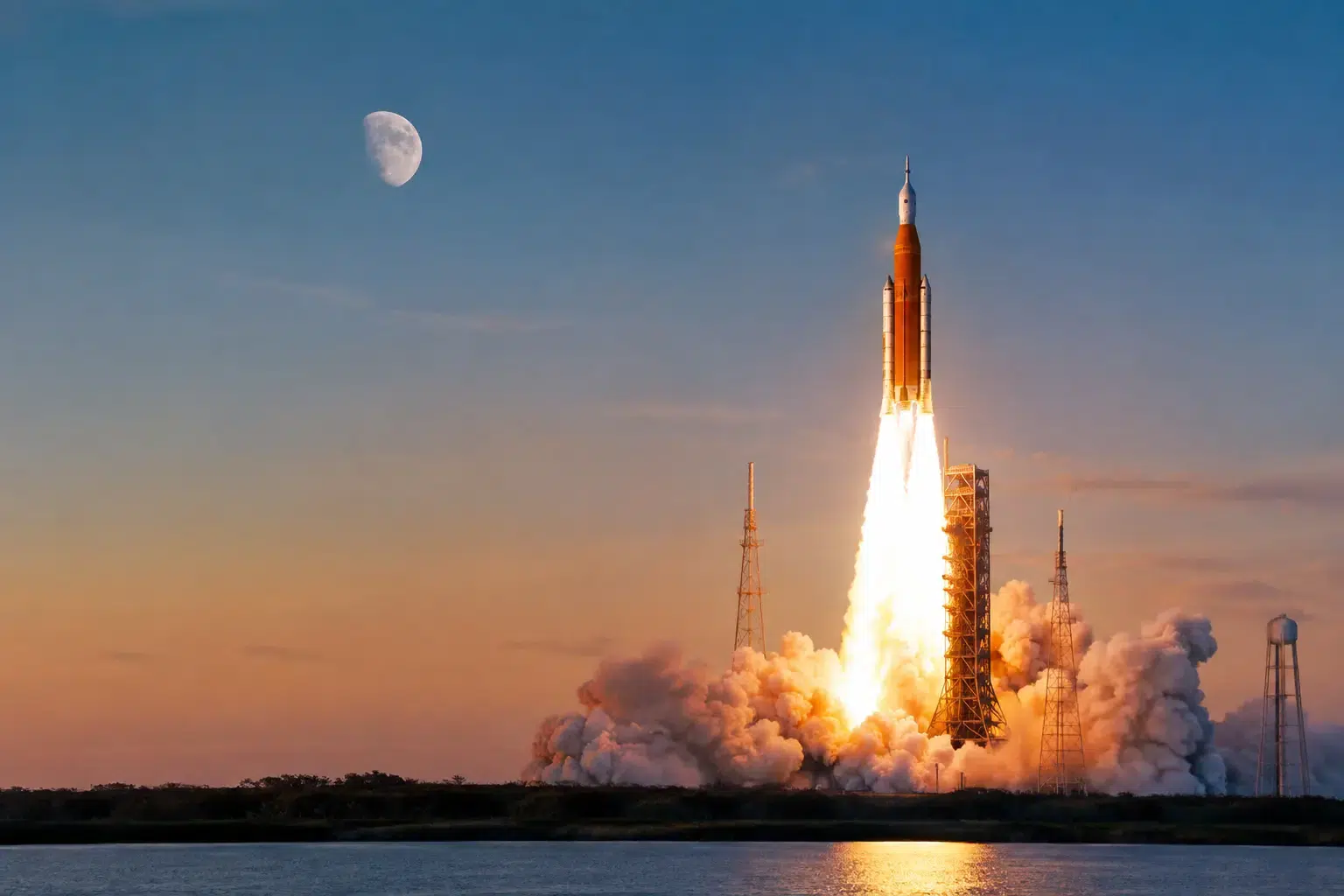
A crewed Orion spacecraft leaving Florida for the Moon will be one of the biggest public spaceflight moments of the decade. But upcoming Artemis mission visibility is not like spotting the ISS on a predictable evening pass. The launch may light up skies across the Southeast for minutes, while the spacecraft itself will quickly become far too faint to see without major telescope support. The real mission-control move is knowing which parts of the flight are viewable, where to be, and when an official trajectory turns possibility into a forecast.
| Mission element | Planning figure | What observers can expect |
|---|---|---|
| Artemis II launch site | Launch Complex 39B, Kennedy Space Center, Florida | A bright SLS ascent potentially visible for several hundred km, weather and launch time permitting |
| Planned crewed flight length | About 10 days | Launch and return are the practical public viewing windows |
| Farthest planned distance | About 370,000 km from Earth | Orion will not be a naked-eye target near the Moon |
| SLS height | 98 m | The vehicle is easy to identify from Florida viewing areas before liftoff |
What upcoming Artemis mission visibility really means
Artemis II is planned as NASA’s first crewed lunar mission since Apollo 17 returned on December 19, 1972. The four-person crew will fly an Orion spacecraft on a lunar flyby and free-return trajectory, rather than land. NASA’s December 2024 program update set Artemis II no earlier than April 2026, but a “no earlier than” date is a planning threshold, not a launch appointment. Hardware readiness, range operations, weather, and the mission’s required trajectory all control the final launch window.
That distinction matters for observers. A precise visibility map needs a launch date, liftoff time, azimuth, and ascent trajectory. Until those are formally published, any statewide or cross-country claim about seeing the rocket is only a broad possibility.
For most people, Artemis visibility has three very different layers: a local Florida launch spectacle, a possible distant view from parts of the southeastern United States, and live mission tracking once the spacecraft is beyond visual range. The last one is not a consolation prize. A ground track, Earth-Moon distance readout, lunar phase display, and mission-event countdown make the journey legible when your eyes cannot follow it.
The launch is the main visual event
At liftoff, the Space Launch System will produce an exceptionally bright plume. SLS stands 98 meters tall and its core stage uses four RS-25 engines alongside two solid rocket boosters. The vehicle’s early ascent can be visible from beaches, roads, parks, and rooftops well beyond the Space Coast if the sky is clear.
From the closest public-viewing areas near Kennedy Space Center, the visual sequence unfolds quickly. The flame appears first, the rocket clears the pad, and the sound arrives later because sound travels roughly 343 meters per second. At a viewing distance of 10 km, expect a delay of about 29 seconds between seeing liftoff and hearing the first deep rumble. At 50 km, that delay is roughly 2 minutes 26 seconds.
Distance is only one part of the forecast. A daytime launch can still be dramatic near the coast, but the bright sky reduces contrast for distant observers. Twilight or night launches can make the exhaust plume visible much farther away, especially after the vehicle climbs above lower atmospheric haze and sunlight catches the expanding plume at high altitude. That is why a rocket seen from 300 km away can look like a luminous fan rather than a point of fire.
Cloud cover is the hard limit. A low marine cloud deck can hide the first 1 to 3 km of ascent from observers who are otherwise perfectly positioned. Thin high clouds may still allow a bright glow through. Check the forecast at your exact observing point, not just the forecast for Cape Canaveral.
Choosing a launch viewing position
If you are traveling to Florida, prioritize an open eastern or northeastern horizon and a legal, preplanned viewing location. The best direction will depend on the actual launch azimuth, which is tied to the mission trajectory. Do not assume every Artemis launch will follow the same path as a previous Florida mission.
For viewers outside Florida, elevation helps. A roof, hilltop, or unobstructed shoreline can extend the time you see the vehicle after it rises above the horizon. A tree line or buildings that block even the first 5 degrees of sky can erase the only portion of the ascent visible from your location.
Use binoculars only after the rocket is safely well above the pad, and never point optical equipment toward the Sun. For a night launch, a phone on a tripod can capture a better result than hand-held zoom. Start recording 2 minutes before liftoff and keep the wide-angle lens active for at least 8 minutes. The launch will move faster than many first-time viewers expect.
Why Orion will disappear from view
Once SLS completes its work and Orion departs toward the Moon, visual observing changes completely. The Moon is about 384,400 km from Earth on average. Artemis II’s planned farthest distance is about 370,000 km from Earth, close to the lunar neighborhood on a human scale but immense for optical viewing.
Orion is roughly 5 meters across at its widest point. At hundreds of thousands of kilometers away, it is far smaller than the resolving power of a backyard telescope. More importantly, it reflects very little sunlight compared with the Moon. It will not appear as a bright companion crossing the lunar disk, nor as a visible moving star beside the Moon.
Even the Moon is a difficult backdrop. Its apparent diameter is about 0.5 degrees, or 30 arcminutes. An object passing thousands of kilometers above or below the lunar limb will not create an obvious visual event from Earth. A true transit would require extremely exact geometry, and it should never be presumed from a general mission diagram.
This is where live tracking becomes the definitive way to follow the mission. Track the Earth-Moon distance in km, watch the spacecraft’s changing position in a solar system simulator, and pair key burns with mission time. Artemis turns from a distant dot into a measurable journey: leaving Earth orbit, crossing the lunar distance, looping around the far side, and committing to the free-return path home.
The return corridor is real, but not a public sky show
Orion’s return to Earth will be fast. Lunar-return spacecraft enter Earth’s atmosphere at roughly 11 km/s, or about 39,600 km/h. Artemis I demonstrated the profile on December 11, 2022, when Orion splashed down in the Pacific Ocean after a 25.5-day uncrewed mission.
A crewed Artemis II return will also target a Pacific splashdown area, but that does not mean the entire United States will see a fireball. Reentry visibility is highly location-dependent. The spacecraft’s precise entry interface, ground track, daylight conditions, clouds, and the location of the final landing zone determine whether any observer has a line of sight.
Unlike a planned rocket launch, a return may offer fewer practical public observation opportunities. Treat reports of a visible streak with caution unless they come with a confirmed ground track and timing. The dependable public experience will be live mission coverage and recovery updates, with any observational map added only after NASA releases the relevant trajectory details.
Build a practical Artemis watch plan
Start with the official launch date and window once NASA confirms them. Then work backward. Check your horizon direction, local cloud forecast, and the Sun’s altitude at liftoff. If the Sun is below the horizon, prepare for a longer-lasting plume display. If it is high in the sky, focus on seeing the vehicle itself during the first few minutes.
Set two alerts: one for the opening of the launch window and one 15 minutes before the target liftoff time. Launches can hold, recycle, or move within a window. A countdown labeled “T-0” is not a guarantee until the rocket actually leaves the pad.
For the flight itself, follow mission milestones rather than hunting for an invisible spacecraft. The translunar injection burn, outbound Earth views, closest lunar approach, communication loss behind the Moon if scheduled, and return-entry timeline each give the mission a moment you can share with family, students, or fellow skywatchers.
Artemis will be visible in more than one way: as a rocket climbing out of Florida, as live numbers racing toward the Moon, and as a crew carrying human spaceflight beyond low Earth orbit again. When the launch window locks in, let the sky forecast decide where you stand and let live tracking carry you the rest of the way.