
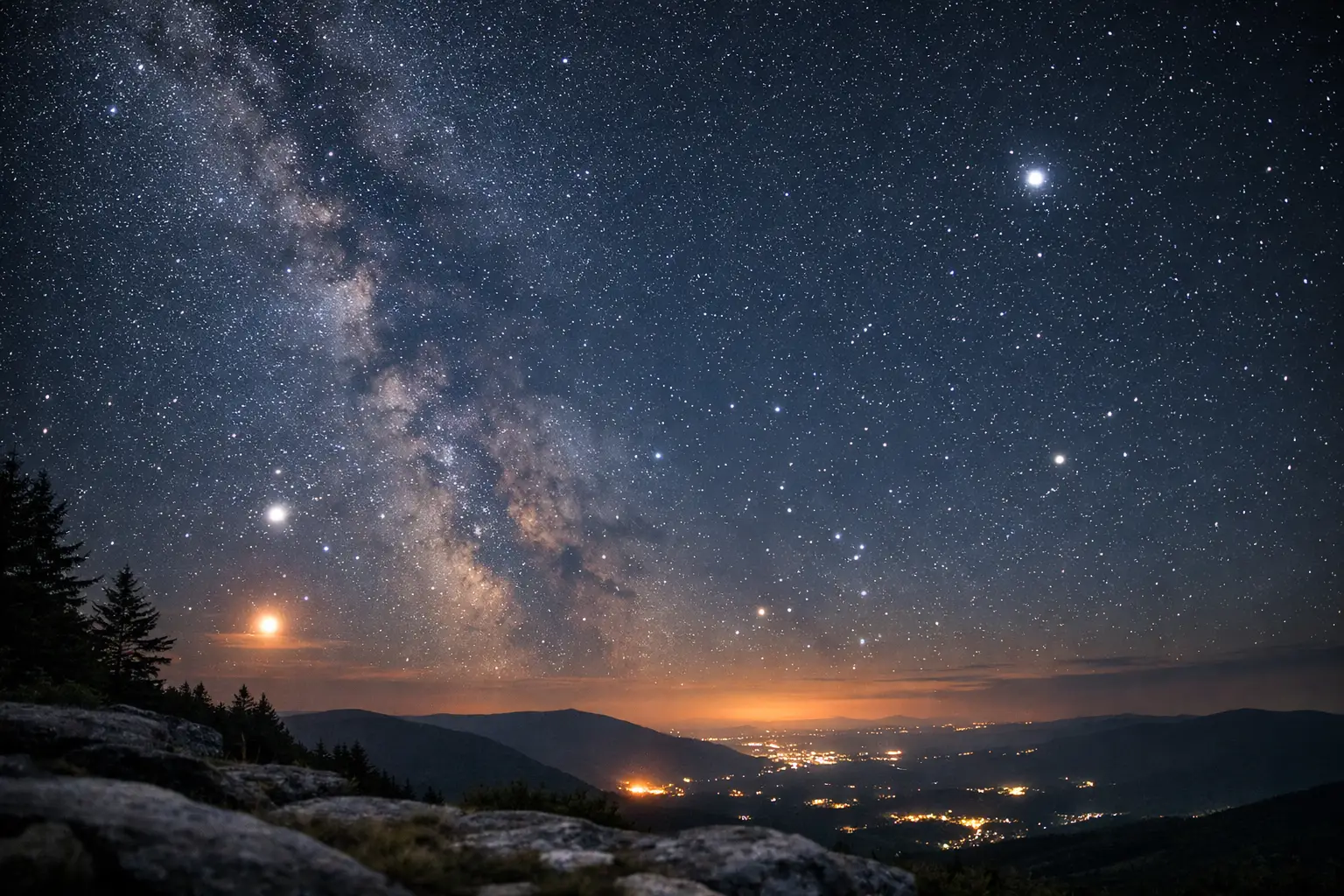
Tonight’s sky has a clear mission profile: Venus and Mars own the western twilight, while Saturn and Neptune take over after midnight. For planet visibility tonight, Monday, July 13, 2026, the key is timing. A planet 10 degrees above the horizon is often lost to trees, haze, and city glow. Wait until it reaches 20 degrees or more, and the view changes fast.
| Planet | Best viewing window | Approx. altitude target | Brightness | What to expect |
|---|---|---|---|---|
| Mercury | Not practical | Under 5° near twilight | About +2 | Too close to the Sun |
| Venus | 45-120 minutes after sunset | 10°-25° west | About -4.0 | Bright evening beacon |
| Mars | 90 minutes after sunset to midnight | 15°-35° west | About +1.5 | Faint orange point |
| Jupiter | Not practical | Within 10° of the Sun | About -1.8 | Hidden in solar glare |
| Saturn | 12:30 a.m. to dawn | 20°-45° southeast | About +0.8 | Best telescopic target |
| Neptune | 1:00 a.m. to dawn | 20°-45° southeast | About +7.8 | Binocular or telescope only |
The windows above are representative for the central United States near 40° north latitude, including the Chicago and Kansas City region. On July 13, sunset is close to 8:25 p.m. CDT there, while astronomical darkness begins around 10:35 p.m. Local clock times can shift by more than an hour across the country, but the sequence of targets remains the same.
Planet Visibility Tonight Starts in the West
Venus is the no-miss target. It is currently the Evening Star, shining at roughly magnitude -4.0. That is bright enough to punch through a blue twilight sky, provided you have an open view toward the western horizon. Start scanning 45 minutes after local sunset. By 9:15 p.m. CDT in the central US, Venus should be roughly 15 degrees high, equal to about one and a half clenched fists held at arm’s length.
A pair of 7×50 or 10×50 binoculars can reveal Venus before the sky becomes fully dark, but do not use binoculars until the Sun is completely below the horizon. Even a brief accidental sweep near the Sun can cause severe eye injury.
Mars is also an evening object, but it is a much tougher catch. At about magnitude +1.5, the Red Planet is roughly 160 times dimmer than Venus. Look farther left and higher than Venus after twilight deepens. Mars will look like a steady, pale orange star rather than a dramatic red disk. Its small apparent size means a backyard telescope is unlikely to show much surface detail tonight, but spotting it with your own eyes is still a satisfying precision find.
The trade-off is simple: wait later for a darker sky, but do not wait so long that Mars sinks into the horizon haze. For most observers, the best Mars window begins about 90 minutes after sunset and lasts until roughly midnight.
Why Mercury and Jupiter Are Off the Board
Mercury is in a poor geometry phase this week, moving through a retrograde stretch that runs from June 29 through July 23, 2026. It sits too close to the Sun to recommend as an observing target on July 13. Its low altitude and bright background sky make a safe, reliable sighting unlikely.
Jupiter is even more firmly in the Sun’s glare. The giant planet reaches conjunction in mid-July 2026, placing it on the far side of the solar system from Earth. Its brilliant magnitude does not help when it is only a few degrees from the Sun in the sky. Mark Jupiter as unavailable, then save your observing time for the planets that can actually clear the horizon.
Saturn Launches After Midnight
Saturn is the main late-night destination. It rises around 12:30 a.m. CDT for observers near 40° north latitude and climbs into the southeastern sky through the predawn hours. At 2:00 a.m., it may be only 20 degrees high. By 4:30 a.m., it can reach about 45 degrees, where atmospheric distortion is significantly reduced.
That altitude gain matters. At 20 degrees above the horizon, you are looking through nearly three times as much atmosphere as you are at the zenith. The planet can shimmer, soften, or shift in color. At 40 degrees and above, the view is usually steadier, especially when humid summer air has settled after midnight.
Saturn shines around magnitude +0.8 in the star field, bright enough for unaided-eye identification once you know where to look. Through a small telescope at 75x to 125x, its rings should be visible as a distinct extension on either side of the globe. A 90 mm telescope can also show Titan, Saturn’s largest moon, as a tiny point nearby under favorable conditions.
Use low magnification first. Center Saturn with a 25 mm eyepiece, confirm the rings, then increase power gradually. If the image turns soft at 150x, the atmosphere is setting the limit, not your telescope. Drop back to the sharpest view and enjoy the planet rather than chasing magnification.
Neptune Requires a Real Search Plan
Neptune rises on a similar schedule to Saturn but is a completely different challenge. At magnitude +7.8, it is beyond naked-eye range even under a very dark sky. Binoculars may show it only as a star-like point, and a telescope is the practical tool for confirming it.
The blue planet is about 4.5 billion km from Earth this month, compared with Saturn’s approximate distance of 1.35 billion km. That distance explains the difference in visual impact. Saturn is an obvious planet with a ring system waiting in the eyepiece. Neptune is a tiny, faint blue-gray disk that rewards careful star-hopping and accurate coordinates.
For a first successful Neptune observation, use a live sky map set to your exact location and time. Center on the correct field with low power, then compare the telescope view to the chart. At 100x to 150x in a steady sky, Neptune can look slightly nonstellar because its apparent disk is about 2.3 arcseconds wide. That is subtle, but it is real.
Make Your Location Part of the Plan
Altitude and time are location-sensitive. In Miami, Venus will sit higher in the evening sky than it does in Minneapolis. In Seattle, a clear western horizon is especially valuable because terrain and marine haze can erase low targets. In Phoenix, dry air can improve contrast but summer heat rising from pavement can make telescopic views unsteady until later at night.
A quick horizon check can save an observing session. Pick a spot where buildings and trees are below 5 degrees in the west for Venus and Mars, then use an open southeastern view for Saturn and Neptune. One clenched fist at arm’s length spans about 10 degrees, so a house that blocks two fists above the horizon removes the first 20 degrees of sky.
If clouds interrupt the evening phase, do not write off the night. Saturn’s best viewing window does not arrive until the early hours of July 14. Set an alarm for 3:30 a.m., let your eyes dark-adapt for 15 to 20 minutes, and turn a quiet summer night into a four-planet mission.